






How to use this page
How this page helps you choose the right rack oven
Choosing the right rack oven comes down to a handful of decisions. Here we walk you through the ones that matter most to help you make a choice that meets your needs and your budget, without any expensive surprises after delivery. When you're ready, use our popular Get Quotes option to connect with verified Australian suppliers so you can compare quotes and buy with confidence.
Common setups
Three common rack oven setups
Cost breakdown
What a commercial rack oven costs, by capacity
A commercial rack oven is priced mainly on output, measured in trays per hour, plus the heat source and steam system it runs. The ranges below help you size your budget before you compare quotes. Installation, ventilation, and a matching proofer are usually quoted separately.
| Capacity | Price rangeIndicative, before GST | What changes the price |
|---|---|---|
| Mini rotary | $18,000 - $40,000 | Element output, steam system, and stainless steel build quality |
| Single rack | $15,000 - $35,000 | Tray and trolley capacity, control sophistication, and included trolleys |
| Double rack | $35,000 - $65,000 | Trolley capacity, heat recovery speed, and proofer compatibility |
| High-output diesel | $45,000 - $85,000+ | Burner output per hour, steam capacity, and heat recovery |
The quoted oven price rarely covers everything you need to bake from day one. Ask each supplier to itemise delivery, positioning, electrical or gas connection, the flue or extraction work, the steam system, and a spare trolley. On a double rack a second trolley keeps the oven loading while one batch proves, and a matching proofer is often a separate line, so compare these in the quote.
Heat source
Electric, gas, or diesel for your rack oven
Choosing between an electric rack oven and a gas rack oven changes the connection work your site needs and your running cost per bake, which depends on local utility pricing and existing connections. Pick it against the power and gas at your site and your daily output.
The cheapest oven to run is usually the one your site is already set up for. With spare three-phase capacity and a tight indoor space, an electric rack oven wins on install. If you bake high volume and have gas at the building, a gas burner recovers faster between loads, at a cost that depends on your gas pricing. Tell each supplier what is connected so the quote reflects real install cost.
New or used
Buying a used rack oven versus new
A used rack oven can cut the upfront cost on a high-ticket purchase, but condition varies widely on a hard-working production asset. Weigh the saving against run hours, service history, and remaining element or burner life.
The single best protection on a used rack oven is seeing it run. Ask the supplier to power it on, bring it to temperature, and rotate the trolley while you watch. Get the run hours, the date of the last service, and confirmation that the steam system, the rotation drive, and the door seal still hold. A unit that cannot be tested before purchase carries far more risk on a production line.
Site and install
Will the rack oven fit your site and services
A rack oven is heavy, tall, and needs the right power or gas, a flue or extraction path, and a level floor that carries the load. The checks below are the ones that change the install cost or stop delivery on the day, so confirm them before you quote.
| Install check | Why it matters |
|---|---|
| Delivery access | A tall, heavy oven can stall at a narrow door, tight corner, or upper floor with no lift |
| Ceiling height | The oven and its flue need headroom, and a rotary body is taller than a single deck |
| Floor load and level | A loaded trolley is heavy, so the floor must carry it and sit level for clean rotation |
| Three-phase power or gas | An electric oven needs spare three-phase capacity; a gas oven needs a sized connection |
| Flue and extraction path | Gas and diesel need a flue and extraction, which drives the largest part of the install cost |
| Trolley and proofer clearance | Leave room to load and rotate the trolley, and a path between the oven and the proofer |
Most install surprises come from a detail the supplier never saw. Send your power and gas connection, ceiling height, floor type, and delivery access with the enquiry, and say whether a proofer is going in alongside the oven. With those in hand each supplier can quote the real install rather than a guess, and you avoid a quote that climbs once they visit the site.
Decide before you quote
What to lock in before you request rack oven quotes
Get these requirements clear upfront and suppliers can provide accurate rack oven quotes the first time, rather than making assumptions.
| 1 | Daily output you need to bake, in trays or trolleys per cycle |
| 2 | Single rack, double rack, or mini rotary to match that output |
| 3 | Heat source available at your site: three-phase power, gas, or neither |
| 4 | Extraction or flue path and the clearance around the oven |
| 5 | Delivery access: door height, ceiling height, and floor load |
| 6 | New or used, and whether you need a matching proofer or spare trolley |
Finance
Finance options for a rack oven
A rack oven is a large upfront cost, and a matching proofer or trolley adds to it. To spread that into a regular repayment, many buyers look at equipment finance alongside the quote comparison. What finance looks like for your business comes down to the answers below.
| Finance question | What it helps you decide | Why it matters |
|---|---|---|
| What could the monthly repayment be? | Whether the unit fits your monthly cash flow before committing to a quote. | Most rack ovens sit in a price range where the monthly repayment is easier to weigh against daily output than the upfront cost alone. |
| Am I likely to get approved? | Whether your business, trading history, and the unit's value are financeable. | HospitalityHub finance works across a panel of lenders, which can improve the chance of finding a suitable approval pathway. |
| Which finance structure suits the purchase? | Whether to compare options such as chattel mortgage, lease, rental, or low-deposit finance. | The right structure can affect ownership, monthly cost, cash flow, and how quickly you can move ahead. |
Finance calculator
Estimate my repayment
Adjust the sliders to estimate your rack oven repayments. Speak with our team for an exact quote based on your profile.
Indicative only. Compare quotes and finance options for rack ovens.
Common questions
Rack oven questions buyers commonly ask
Quick answers to the most-searched questions about rack ovens and how HospitalityHub works.
Why use HospitalityHub to buy a rack oven?
HospitalityHub helps you compare multiple reputable Australian suppliers with a single enquiry, saving you time and effort. Instead of contacting suppliers individually, you can compare suitable devices, technology, compliance requirements, service support, and ongoing consumables in one place. This helps you find the right rack oven for your treatments while avoiding costly mistakes and making a more informed purchasing decision.
How much does a rack oven cost?
As an indicative guide, before GST: a single rack oven runs $15,000 to $35,000, a mini rotary $18,000 to $40,000, a double rack $35,000 to $65,000, and a high-output diesel rack oven $45,000 to $85,000 or more. Price is driven by tray and trolley capacity, burner or element output, the steam system, control sophistication, and heat recovery speed. Installation, ventilation, and a matching proofer are usually quoted separately.
Is it worth buying a used rack oven?
It can be, if the unit is in good condition and you can see it run. A used rack oven cuts the upfront cost on a high-ticket purchase, but elements, burners, door seals, and the trolley rotation drive all wear with use. Ask for run hours, service records, and a power-on test that brings the oven to temperature and rotates the trolley. Warranty is often short or sold as is, so price in the risk of an early repair.
What is the difference between a rack oven and a deck oven?
A rotary rack oven bakes a full trolley of trays at once and turns it for an even bake, which suits high-volume, consistent output. A deck oven bakes directly on stone or steel decks and gives more control over individual products, which suits artisan loaves and pizza. For a commercial bakery oven handling steady volume across many trays, a rack oven is the faster, more even choice.
Do I need three-phase power for a rack oven?
An electric production rack oven almost always needs three-phase power because it draws a heavy load. Confirm your switchboard has spare capacity before you commit, since upgrading supply can cost more than the oven install. Gas and diesel ovens reduce the electrical demand but add a flue and extraction. Tell each supplier what power and gas you have so the quote reflects the real connection cost.
How many trays does a rack oven hold?
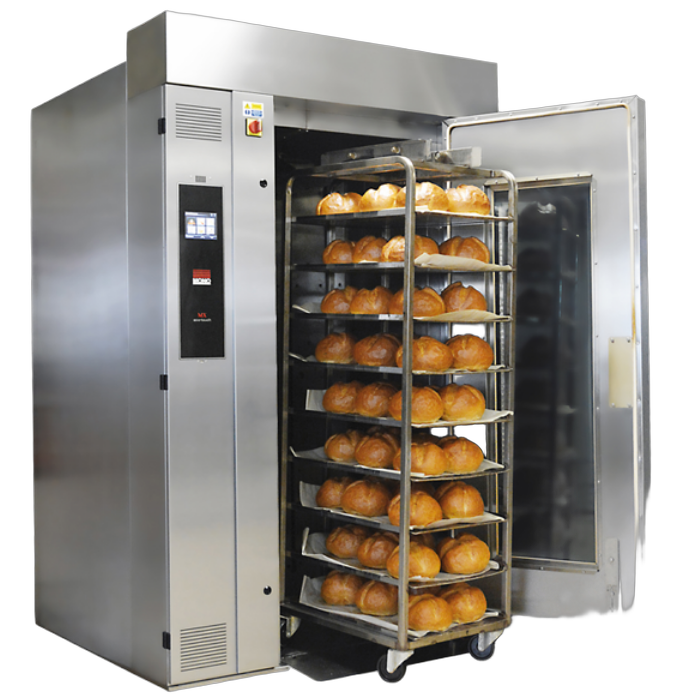
It depends on the oven capacity and the tray size. A single rack oven holds around 15 to 18 trays on one trolley, a mini rotary 10 to 15, and a double rack 32 to 40 across two trolleys. Tray dimensions matter, so confirm the oven takes your existing trays before you buy, or budget for trays that match the new oven.
Do I need a rack oven with proofer?
For yeasted products, yes, most bakeries pair a rack oven with a proofer so dough rises under controlled heat and humidity before baking. Some setups use the same trolley in both the proofer and the oven, which keeps loading fast. If you are sizing a new line, decide whether you need a matching proofer upfront so it can be quoted alongside the oven rather than added later.
Are rack ovens made from stainless steel?
Most commercial rack ovens use a stainless steel body and chamber because it stands up to constant heat, daily cleaning, and a humid bakery environment. The grade and thickness vary, which affects both price and how long the oven lasts. Ask each supplier about the steel grade on the chamber and door, since a heavier build holds up better on a busy production line.
How long does finance pre-approval take?
Equipment finance pre-approval is usually quick, often within 1 to 2 business days once you provide basic business and financial details. Pre-approval lets you compare quotes knowing your monthly cost and borrowing capacity, without committing to a purchase.
What documents do I need to apply for equipment finance?
For most equipment finance under a set threshold, lenders ask for limited paperwork: business ABN and trading history, recent bank statements, and details of the oven being financed. Larger amounts can need business financials or tax returns.
Why HospitalityHub
Why buyers choose HospitalityHub
Helping Australian hospitality buyers compare suppliers.