
Key takeaways
- Countertop blast chiller (3-5 tray, new): $3,000 - $8,000 AUD (2026) - suits cafes, small bakeries and low-volume kitchens running under 20 kg per cycle
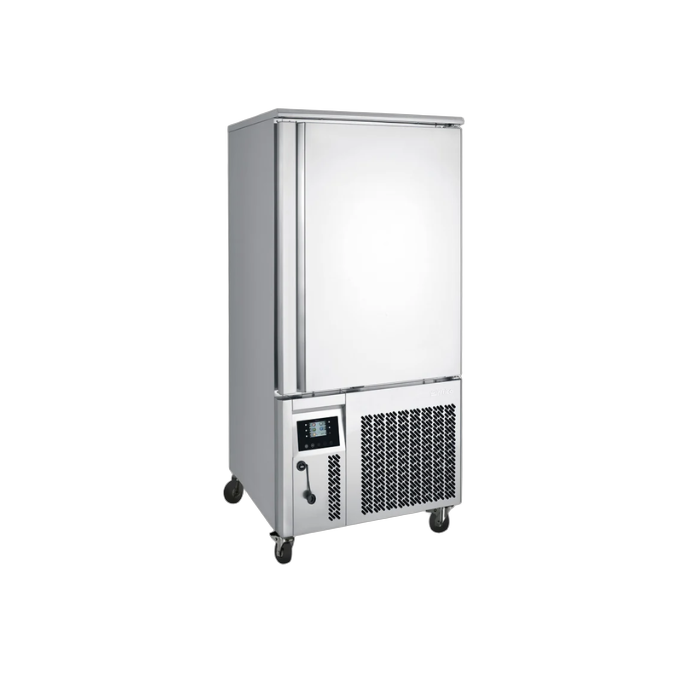
- Reach-in blast chiller (5-15 tray, new): $8,000 - $25,000 AUD - standard for mid-size restaurants, hotels and aged care doing 20-80 kg per cycle
- Roll-in blast chiller (20-40+ tray, new): $25,000 - $72,000+ AUD - high-volume catering, central kitchens and food manufacturing at 80-300+ kg per cycle
- Payback period: 6 - 18 months - fastest in kitchens with high food waste, batch-cook models or HACCP compliance gaps
- Annual running costs: $800 - $3,500 - energy, defrosting, condenser maintenance and gasket replacement
- Food waste reduction: 3 - 8% of food cost - blast-chilled prep lasts 3-5 days vs 24 hours for fridge-cooled equivalents
- Used / refurbished: $1,500 - $30,000 - check compressor hours, probe calibration and gasket condition before purchase
Introduction
A blast chiller drops cooked food from 70C to 3C in under 90 minutes, compared to 4-8 hours in a standard commercial fridge. In 2026, Australian commercial kitchens are investing in blast chillers at the highest rate in a decade. Three pressures are converging: food costs making waste reduction a margin priority, HACCP audit enforcement tightening across NSW, VIC and QLD, and labour shortages pushing kitchens toward batch-cook-and-chill workflows that reduce the number of cooks needed per service.
This price guide covers what blast chillers cost to buy and run across every kitchen type in Australia, plus the payback model that justifies the investment. Get quotes for blast chillers to compare and buy from verified Australian suppliers once you have confirmed which size fits your kitchen. For a broader overview of types and features, see the HospitalityHub blast chiller buying guide.
Kitchens where blast chillers deliver the strongest payback:
- Restaurants and hotels batch-cooking sauces, soups, proteins and desserts for multi-day service
- Aged care and hospital kitchens required to meet strict HACCP cooling time protocols
- Bakeries and patisseries chilling pastry, ganache and doughs between production steps
- Catering operations preparing food 2-5 days before events
- Any kitchen where food waste exceeds 5% of food cost and prep is done in advance
Choose your configuration by kitchen type
Before comparing prices, confirm which blast chiller size matches your production volume and floor space. Your choice here sets the price bracket.
Configuration | Capacity | Best For |
|---|---|---|
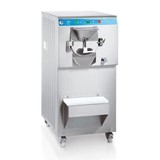
Countertop (3-5 tray) |
10 - 20 kg per cycle |
Cafes, small bakeries, dessert bars, gelato production |
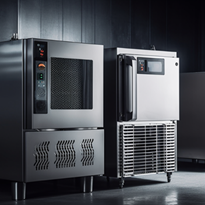
Reach-in (5-15 tray) |
20 - 80 kg per cycle |
Mid-size restaurants, hotels, pubs, aged care facilities |
Roll-in (20-40+ tray) |
80 - 300+ kg per cycle |
Large hotels, catering companies, food manufacturers, central production kitchens |
Choose reach-in if your kitchen produces 20-80 kg of food per batch cycle. This is the most common size for Australian restaurants and hotels. A 10-tray GN 1/1 reach-in handles most dinner service prep in a single cycle and fits a footprint of approximately 0.8 x 0.8 m.
Choose roll-in if you batch-cook at scale or run a central kitchen. Roll-in models accept mobile racking loaded with 20-40+ GN trays, handling 100-300+ kg per cycle. They are the standard for catering operations, aged care groups and hotel chains with central production kitchens in metro Sydney, Melbourne and Brisbane.
Evaluate the key specifications
With your configuration confirmed, these are the specs that determine whether a given unit fits your production volume, food types and compliance requirements.
Specification | Typical Range | Buyer Consideration |
|---|---|---|
Chill capacity (kg per 90 min) |
10 - 300+ kg |
Size to your largest single batch plus 15-20% headroom for peak production |
Chill modes |
Soft chill / hard chill / shock freeze |
Soft chill protects delicate pastry and fish; hard chill suits dense proteins; shock freeze takes food to -18C |
Core probe |
1 - 3 probes |
Core probe monitoring is required for HACCP compliance logging - confirm the unit includes at least one |
GN compatibility |
GN 1/1 or GN 2/1 |
GN 1/1 is the standard for most kitchens; GN 2/1 doubles tray area for high-volume operations |
HACCP data logging |
USB / WiFi / built-in printer |
Automatic temperature logging simplifies audit documentation - manual records are error-prone |
Refrigerant |
R404A / R290 / R452A |
R290 is increasingly standard on new units; R404A faces phase-down under Australian HFC regulations |
Power supply |
15A single phase / 32A three phase |
Roll-in units typically need three-phase power - confirm your kitchen's electrical capacity before purchase |
Understand the full cost breakdown (2026 prices)
Purchase price is only part of the picture. Energy consumption, maintenance and the food cost savings that fund the payback all belong in the approval submission.
Category | Price Range (AUD) | Notes |
|---|---|---|
Countertop (3-5 tray, new) |
$3,000 - $8,000 |
10-20 kg capacity; 240V single phase; fits on existing benchtop |
Reach-in (5-15 tray, new) |
$8,000 - $25,000 |
20-80 kg; most popular size for Australian restaurants and hotels |
Roll-in (20-40+ tray, new) |
$25,000 - $72,000+ |
80-300+ kg; mobile racking compatible; three-phase power required |
Used / refurbished |
$1,500 - $30,000 |
Check compressor hours, probe calibration, gasket condition and refrigerant type |
Annual energy cost |
$400 - $2,000 |
Depends on cycle frequency, unit size and ambient kitchen temperature |
Annual maintenance |
$400 - $1,500 |
Condenser cleaning, gasket inspection, probe recalibration, defrost system check |
The payback calculation for a blast chiller is built on three savings streams. First, food waste reduction: a kitchen spending $15,000/week on food with 6% waste ($46,800/year) can cut waste by half with blast chilling, saving $23,400/year. Second, labour: batch-cook-and-chill workflows reduce the number of cooks needed for service by 0.5-1.0 FTE, worth $30,000-$60,000/year. Third, shelf life extension: blast-chilled prep lasts 3-5 days versus 24 hours, reducing emergency orders and last-minute purchasing premiums. A $15,000 reach-in unit recovers its cost in 6-10 months on a kitchen achieving even one of these three savings. Get quotes for blast chillers to compare and buy from verified Australian suppliers to match pricing to your kitchen's payback model.
Depreciation and asset planning
Commercial kitchen equipment carries an ATO effective life of 10-15 years. The diminishing value depreciation rate is approximately 13-20%. The instant asset write-off threshold of $20,000 covers countertop and most reach-in models for eligible businesses. Roll-in units above this threshold are depreciated over the effective life. For new venues where kitchen budgets are tight, equipment finance or rental from $150-$800/month spreads the capital cost.
Residual value at 8-10 years is 10-20% for well-maintained units from established brands (Irinox, Williams, Friginox, Tecnomac). Units running R404A refrigerant face declining support under Australia's HFC phase-down schedule, which reduces long-term resale value compared to R290 models.
Evaluate suppliers
You are ready to go to market. Use this checklist to assess each supplier against the same criteria.
Factor | What to Ask |
|---|---|
Chill performance |
What is the tested chill time from 70C to 3C at the rated capacity, and can the supplier provide independent test data? |
GN compatibility |
Does the unit accept GN 1/1 trays as standard, and what is the maximum tray count per cycle? |
HACCP logging |
Does the unit include automatic HACCP data logging with USB, WiFi or printer output? |
Core probe |
How many core probes are included, and what does a replacement probe cost? |
Refrigerant type |
Is the unit running R290 or R404A? What is the long-term servicing outlook for the refrigerant used? |
Power requirements |
What are the exact power, circuit and ventilation clearance requirements? |
Warranty |
What is the warranty period on the compressor, cabinet and electronic controls separately? |
Service coverage |
Is there a local service agent in your state (NSW, VIC, QLD, WA, SA)? |
Spare parts |
Are gaskets, probes and control boards stocked in Australia or imported to order? |
Delivery and installation |
Is delivery, positioning and commissioning included in the purchase price? |
Frequently asked questions
How much does a blast chiller cost in Australia in 2026?
Countertop models start from $3,000, reach-in units from $8,000-$25,000, and roll-in models from $25,000-$72,000+. Used units are available from $1,500-$30,000 depending on size and condition.
What is the typical payback period for a blast chiller?
Most reach-in units pay back in 6-12 months through food waste reduction alone. Kitchens that also adopt batch-cook-and-chill workflows see additional labour savings of $30,000-$60,000/year, accelerating payback further.
How long does a commercial blast chiller last?
A well-maintained blast chiller lasts 10-15 years. Compressor condition and gasket integrity are the primary factors that determine whether the unit reaches the upper end of that range.
Does a blast chiller replace a commercial fridge?
No. A blast chiller rapidly cools food to safe temperatures; a fridge maintains food at those temperatures for storage. Most kitchens blast-chill food then transfer it to a fridge or freezer for holding.
What food safety standard requires blast chilling in Australia?
The Food Standards Code Standard 3.2.2 requires potentially hazardous food to pass through the temperature danger zone (60C to 5C) as quickly as possible. A blast chiller is the most reliable way to meet the 90-minute cooling target specified in most HACCP plans.
Summary
- Countertop blast chillers start from $3,000; reach-in from $8,000; roll-in from $25,000 (AUD, 2026)
- Payback is 6-18 months through food waste reduction, labour savings and extended shelf life
- Size to your largest batch plus 15-20% headroom, not your average batch
- HACCP data logging and core probe monitoring should be standard features, not optional extras
- Annual running costs sit at $800-$3,500 for energy and maintenance combined
- R290 refrigerant units are the better long-term investment as R404A faces phase-down in Australia
Ready to source your blast chiller?
Don't waste time contacting suppliers individually. HospitalityHub gives you direct access to verified Australian blast chiller suppliers - compare models, specs and pricing in one place, then request quotes from suppliers best matched to your kitchen.
- Compare models - filter by capacity, configuration and region
- Request quotes - contact multiple verified suppliers with a single enquiry
- Contact suppliers directly - speak to specialists who service your state
→ Get and compare blast chiller quotes now →