

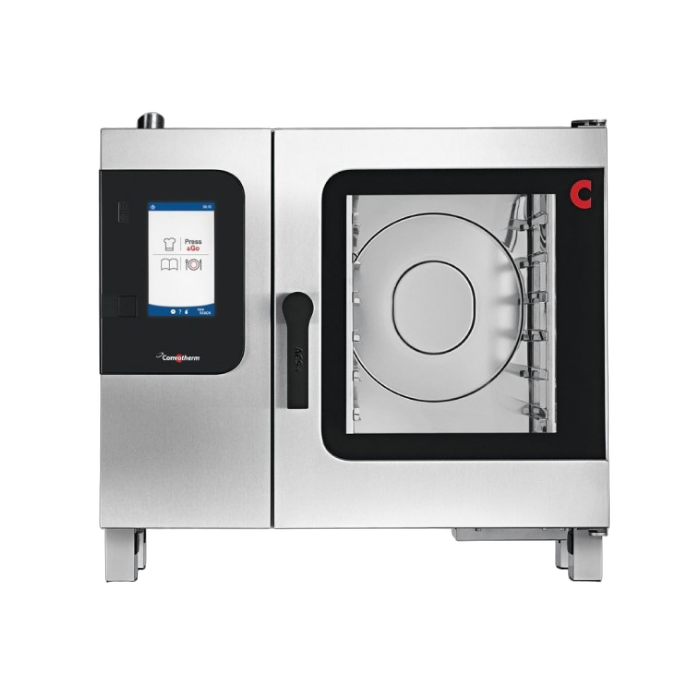





How to use this page
How this page helps you choose the right commercial combi oven
Choosing the right commercial combi oven comes down to a handful of decisions. Here we walk you through the ones that matter most to help you make a choice that meets your needs and your budget, without any expensive surprises after delivery. When you're ready, use our popular Get Quotes option to connect with verified Australian suppliers so you can compare quotes and buy with confidence.
Common setups
Three common commercial combi oven setups
Cost breakdown
What a commercial combi oven costs, by tray capacity
A combi oven is priced mainly on how many gastronorm trays it holds, then on how it makes steam and how much the controls automate. The ranges below help you size your budget before you compare quotes.
| Tray capacity | Price rangeUsually, before GST | What changes the price |
|---|---|---|
| 6 - 10 trays (compact) | $8,000 - $15,000 | Boilerless or boiler steam, control level, and self-cleaning |
| 10 - 20 trays (floor model) | $15,000 - $25,000 | Electric or gas, automation and cleaning systems, energy efficiency |
| 20 - 40 trays (large floor and roll-in) | $25,000 - $40,000+ | 2/1 GN pans, roll-in trolley format, and install scope |
Steam system and automation are the biggest swings at a given size. A boiler model with automatic cleaning and a multi-point probe costs more than a boilerless unit with manual controls and the same tray count. Ask each supplier to quote delivery, installation, water filtration, and a starter set of pans as separate lines so the ovens compare cleanly.
Electric or gas
Electric or gas commercial combi oven
Suppliers list the same machine as a commercial combi oven, combination oven, combi steamer, or convection steam oven. Whichever name is on the listing, the first split that changes your install and your shortlist is how it is powered.
Ask each supplier to price the power or gas connection, water treatment, and any flue or hood work as part of the quote, because a cheaper gas unit can cost more once the gas fitting and ventilation work are added. If your site has no gas line and adding one is not practical, electric is usually the realistic shortlist.
Steam system
Boiler or boilerless combi oven steam
Combi ovens make steam one of two ways: a dedicated boiler that generates steam on demand, or injection of water into the hot cooking chamber, sold as boilerless. The right choice follows how hard your menu works the steam.
Hard water scales a boiler fast. If you quote a boiler model, quote the water filtration or treatment with it and ask what the service schedule looks like in your area. Boilerless units still need filtered water, just with less at stake.
New or used
Buying a used commercial combi oven versus new
A used commercial combi oven can cut the upfront cost, but steam and water do more damage inside these machines than inside a dry oven. Weigh the saving against scale, door seals, and what the controls can still do.
A used oven can look clean and still be scaled inside. Ask the seller to run a steam cycle and a combi cycle while you watch: the door seal, steam recovery, probe reading, and cleaning program all show their condition in use, and the service records show how the water was treated.
Site and services
Will the commercial combi oven run on your site
A combi oven touches more services than most kitchen equipment: power or gas, water in, waste out, and ventilation above. These are the checks that change the install cost or the model you can buy.
| Install check | Why it matters |
|---|---|
| Power supply | Compact units can run on single phase; most floor models need spare three phase capacity, and gas models need a gas line |
| Water supply and treatment | The oven needs a cold water connection, and suppliers specify filtration because scale and chlorides damage the steam system |
| Drainage | Steam cycles and cleaning programs discharge hot water, so the unit needs a drain connection rated for it |
| Ventilation | Most installs sit under an exhaust hood; some compact units take a matching condensation hood instead, so confirm what your site needs |
| Delivery access | Floor models and roll-in units are heavy and deep, so measure doors, corridors, and the final position before you quote |
Suppliers vary on what the quote covers: some include delivery, positioning, water connection, and commissioning, others deliver to the door. Ask each supplier to list what is included and what your plumber, electrician, or gasfitter handles, so quotes compare on the same scope.
Decide before you quote
What to lock in before you request commercial combi oven quotes
Get these requirements clear upfront and suppliers can provide accurate commercial combi oven quotes the first time, rather than making assumptions.
| 1 | Tray capacity and pan size, 1/1 or 2/1 GN, for your biggest service |
| 2 | Electric or gas, and the power or gas supply available on site |
| 3 | Boiler or boilerless steam, based on how hard your menu steams |
| 4 | The jobs it must cover: steaming, roasting, baking, regeneration, or overnight cooking |
| 5 | Your water quality, and the filtration or treatment the site needs |
| 6 | Automatic cleaning, and where the unit will drain |
| 7 | Footprint and delivery path, including stand, stacking, or trolley access |
Finance
Finance options for a commercial combi oven
A commercial combi oven is a meaningful upfront cost for a commercial kitchen. To spread that into a regular repayment, many buyers look at equipment finance alongside the quote comparison. What finance looks like for your business comes down to the answers below.
| Finance question | What it helps you decide | Why it matters |
|---|---|---|
| What could the monthly repayment be? | Whether the unit fits your monthly cash flow before committing to a quote. | Most commercial combi ovens sit in a price range where the monthly repayment is easier to weigh against daily covers than the upfront cost alone. |
| Am I likely to get approved? | Whether your business, trading history, and the unit's value are financeable. | HospitalityHub finance works across a panel of lenders, which can improve the chance of finding a suitable approval pathway. |
| Which finance structure suits the purchase? | Whether to compare options such as chattel mortgage, lease, rental, or low-deposit finance. | The right structure can affect ownership, monthly cost, cash flow, and how quickly you can move ahead. |
Finance calculator
Estimate my repayment
Adjust the sliders to estimate your combi oven repayments. Speak with our team for an exact quote based on your profile.
Indicative only and not a quote, approval or offer of finance.
Need finance before choosing a commercial combi oven?
Check hospitality finance options in under a minute, with no obligation.
Common questions
Commercial combi oven questions buyers commonly ask
Quick answers to the most-searched questions about commercial combi ovens and how HospitalityHub works.
Why use HospitalityHub to buy a commercial combi oven?
Most buyers want to compare a few quotes before committing, and on a combi oven the tray capacity, electric or gas, steam system, and install scope make quotes hard to line up. HospitalityHub connects you with verified Australian suppliers in one go, covering new and used commercial combi ovens, so you can compare price, capacity, steam systems, and service support side by side without ringing around suppliers one by one.
How much does a commercial combi oven cost?
As a guide, usually before GST: a compact 6 - 10 tray unit runs $8,000 - $15,000, a 10 - 20 tray floor model $15,000 - $25,000, and a 20 - 40 tray large floor or roll-in unit $25,000 - $40,000+. Tray capacity changes the price most, along with boilerless or boiler steam, electric or gas, automation and cleaning systems, and on the largest units 2/1 GN pans, roll-in trolley format, and install scope.
Is it worth buying a used commercial combi oven?
It can be, if the steam system is sound. A used unit cuts the upfront cost, but scale builds up inside boilers and chambers, and door seals, gaskets, and probes all wear. Ask for service and descaling records, watch it run a steam cycle and a combi cycle before paying, and price in the shorter warranty.
What does a combi oven do that a convection oven does not?
A convection oven cooks with dry circulating heat only. A combi oven adds steam: it can steam, roast with convection, or combine the two in one chamber with humidity control through the cook. That covers steaming vegetables and rice, roasting with less shrinkage, baking, regenerating plated food, and overnight low-temperature cooking, which is why many kitchens replace several pieces of equipment with one combi.
What size combi oven do I need?
Size on your biggest service, not your average one. A cafe or small restaurant is commonly covered by a compact 6 - 10 tray unit, a busy restaurant or pub kitchen by 10 - 20 trays, and banquet, catering, or production work by 20 - 40 trays or a roll-in trolley unit. Pan size matters too: 1/1 GN suits most kitchens, while 2/1 GN pans double the capacity per shelf for production volume.
Can a commercial combi oven run on single phase power?
Compact models are sold in single phase versions, which is why small kitchens often start there. Most 10 tray and larger electric units need a three phase circuit, and the largest draw enough that spare board capacity is worth confirming early. If three phase is not available and cannot be added affordably, a gas model or a compact electric unit may be the realistic shortlist.
Does a combi oven need a water connection and filtration?
Yes. A combi oven needs cold water in and a drain out, and suppliers specify water filtration because scale and chlorides damage the steam system and chamber. In hard water areas the supplier may recommend extra treatment such as softening or reverse osmosis. Quote the filtration and its cartridge schedule with the oven, because it is a running cost that varies by site.
Does a commercial combi oven need an exhaust hood?
Most installs sit under the kitchen's mechanical exhaust hood, and gas models need flue or ventilation work as part of a licensed gas installation. Some compact electric units can be installed with a matching condensation hood where a full canopy is not available. Ventilation requirements depend on the unit and your site, so confirm them with the supplier and your mechanical contractor before you commit.
What maintenance does a commercial combi oven need?
Daily cleaning, which most current units handle with built-in automatic cleaning programs, plus descaling where the water and steam system require it, and replacement of door gaskets and water filter cartridges over time. As a benchmark, plan around $300 - $800 a year for servicing depending on use. Ask each supplier what the service schedule and consumables look like for the specific model.
Can a combi oven replace other kitchen equipment?
Often, yes - that is the usual case for buying one. A combi covers work otherwise spread across a convection oven, a steamer, and in some kitchens a holding cabinet, and regeneration mode can take over reheating for banquet service. It does not replace a salamander, fryer, or cooktop, so map your menu against the modes before you assume a one-for-one swap.
Can I finance a commercial combi oven?
Yes. Commercial combi ovens are commonly financed through structures such as chattel mortgage, lease, rental, or low-deposit finance, on new and many used units. Repayments depend on the price, the term, and your business profile, so compare finance options alongside your supplier quotes.
Why HospitalityHub
Why buyers choose HospitalityHub
Helping Australian hospitality buyers compare suppliers.