
Key takeaways
- Purchase price: Commercial undercounter glasswashers cost $2,000-$8,000 in Australia (2026 AUD) depending on rack size, cycle speed and features like built-in water softening.
- Detergent and rinse aid: $600-$1,500/year - the largest ongoing cost, driven by cycles per day, dosing calibration and chemical quality.
- Water softening: $200-$500/year for salt and cartridge replacement on built-in softeners, or $1,200-$2,500 upfront for a separate reverse osmosis unit that eliminates most manual polishing entirely.
- Annual servicing: $300-$800/year covering wash arm inspection, heating element check, seal condition and dosing pump calibration.
- Polishing labour saved: A quality undercounter glasswasher with reverse osmosis or built-in softening reduces or eliminates 30-60 minutes of manual glass polishing per shift - at $30-$35/hour casual bar staff rates, that is $4,000-$10,000/year in labour savings alone.
- 5-year TCO: 5-year TCO: $10,000-$18,000 including purchase, chemicals, water treatment and servicing including purchase, chemicals, water treatment and servicing - offset by $20,000-$50,000 in polishing labour savings over the same period.
- Commercial undercounter glasswashers are available from verified Australian suppliers on HospitalityHub.
Commercial undercounter glasswasher costs: The numbers that change the business case (2026)
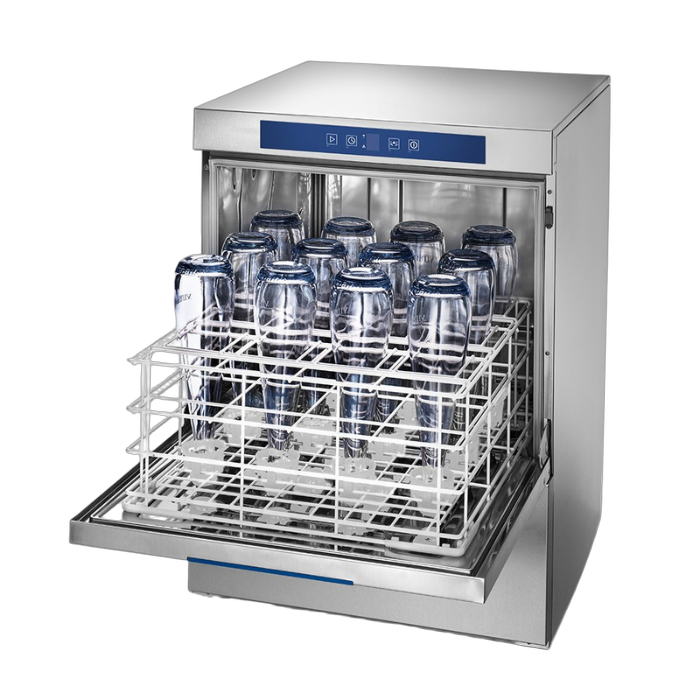
A commercial undercounter glasswasher is one of the lowest-cost items in a bar fit-out at $2,000-$8,000, but its running cost model is where most operators lose money. The pattern is predictable: buy the cheapest unit, skip the water softener, then spend 45 minutes every shift hand-polishing cloudy glasses because the rinse water leaves mineral spots. At $30-$35/hour casual bar staff rates in NSW and VIC, that polishing labour costs more per year than the machine itself.
This guide breaks down every cost line for commercial undercounter glasswashers in Australia so bar managers, venue owners and procurement leads can build a complete cost model that includes the labour savings most quotes ignore. For detailed feature and selection guidance, the undercounter glasswasher guide covers the full range. To compare pricing, get quotes for commercial undercounter glasswashers on HospitalityHub.
Operations where cost modelling matters most:
- Cocktail bars and wine bars where glass presentation directly affects customer perception and pricing power
- Pubs, clubs and RSLs running 300-800+ glasses per shift across beer, wine and spirits service
- Cafes and restaurants with high-turnover beverage programs and limited bar staff
- Multi-venue operators standardising glasswasher cost budgets across locations
Choose your cost profile
Before modelling costs, confirm which usage tier matches your operation. Your tier here sets the chemical consumption, water treatment requirement and servicing frequency.
Usage Tier | Glasses/Day | Annual Running Cost |
|---|---|---|
Light use (cafe, small bar) |
100-300 |
$600-$1,200/year |
Standard use (busy bar, restaurant) |
300-600 |
$1,200-$2,200/year |
Heavy use (high-volume pub, club, RSL) |
600+ |
$1,800-$3,000/year |
Light use operations can stretch service intervals to 12 months and may not need a dedicated water softener if local water hardness is below 100 ppm.
Heavy use operations should budget for 6-monthly servicing and a reverse osmosis or built-in water softening system. At 600+ glasses/day, the polishing labour saving alone justifies a $1,500-$2,500 reverse osmosis unit within 3-4 months.
Evaluate the key cost lines
With your usage tier confirmed, these are the cost lines that make up your annual running budget.
Cost Line | Typical Range (AUD) | Frequency |
|---|---|---|
Detergent |
$400-$1,000/year |
Ongoing - 1-3 mL per cycle, auto-dosed |
Rinse aid |
$200-$500/year |
Ongoing - 0.3-1 mL per cycle |
Water softener salt/cartridges |
$200-$500/year |
Monthly salt top-up or quarterly cartridge replacement |
Energy |
$200-$600/year |
2.5-4.5 kW draw during wash cycle at ~$0.30/kWh |
Annual service |
$300-$800/visit |
Annually (light use) or 6-monthly (heavy use) |
Door seal replacement |
$60-$200 |
Every 2-3 years |
Understand the full 5-year TCO (2026 prices)
Purchase price is only part of the picture - the real business case for a commercial undercounter glasswasher is built on the polishing labour it eliminates, not just the running cost it adds.
Category | Price Range (AUD) | Typical Configuration |
|---|---|---|
Entry-level new (400 × 400 mm rack) |
$2,000-$4,000 |
60/120 sec cycle, gravity drain, manual dosing |
Mid-range new (400 × 400 or 500 × 500 mm) |
$4,000-$6,500 |
30/60/120 sec cycles, drain pump, auto-dosing, built-in softener |
High-spec new (500 × 500 mm) |
$6,500-$8,000+ |
Multiple programmes, heat recovery, integrated RO option |
Used/refurbished |
$800-$3,000 |
Check heating element, wash arms, seals and dosing pump |
5-year running cost (standard use) |
$6,000-$11,000 |
Chemicals, water treatment, energy, servicing, one seal replacement |
5-year polishing labour saved |
$20,000-$50,000 |
30-60 min/shift at $30-$35/hr casual rate, eliminated by RO or softener |
A mid-range undercounter glasswasher at $5,000 with a reverse osmosis unit at $1,500 costs $12,000-$18,000 over 5 years including all running costs. It saves $20,000-$50,000 in polishing labour over the same period. For a unit at $2,000-$8,000, get quotes for commercial undercounter glasswashers to compare pricing from verified Australian suppliers.
Plan the asset (depreciation and financing)
The ATO effective life for commercial warewashing equipment is 10 years. Under diminishing value, the depreciation rate is 20%; prime cost is 10% per annum. The instant asset write-off threshold for 2025-26 is $20,000 - all commercial undercounter glasswashers fall within this.
Used undercounter glasswashers depreciate quickly due to heating element and seal wear. Expect 5-15% residual value at 8-10 years. Rental and fixed-price package arrangements (machine + chemicals + servicing at $50-$80/week) are common from major suppliers including Norris and Winterhalter.
Evaluate suppliers
You are ready to go to market. Use this checklist to assess each supplier against the same criteria.
Factor | What to Ask |
|---|---|
Glass capacity per rack |
How many glasses fit per rack for my glass types (wine, beer, cocktail, spirit)? |
Cycle time |
What is the fastest cycle and at what temperature? Does a 30-second cycle achieve thermal sanitisation? |
Water softening |
Is a water softener built-in or a separate add-on? Do you offer reverse osmosis integration? |
Chemical compatibility |
Does this machine require proprietary chemicals or support third-party suppliers? |
Power supply |
Is this a 10-amp or 15-amp unit? Does my bar have the correct power point? |
Warranty |
What is covered - heating element, wash pump, dosing system, cabinet? Duration? |
Service network |
Do you have technicians in my state? What is the response time for breakdowns? |
Rental or package |
Do you offer fixed-price weekly packages that include machine, chemicals and servicing? |
Drain type |
Is this gravity drain or pump-out? My drain point is above floor level. |
Noise level |
What is the rated noise level? This unit sits under a customer-facing bar. |
Frequently asked questions
How much does it cost to run a commercial undercounter glasswasher per year?
Annual running costs sit at $600-$1,200 for light use (100-300 glasses/day), $1,200-$2,200 for standard use (300-600 glasses/day) and $1,800-$3,000 for heavy use (600+ glasses/day) in 2026 AUD. Chemicals are the largest single cost line.
Do i need a water softener or reverse osmosis with my undercounter glasswasher?
In hard water areas (most of Adelaide, Perth and regional QLD), yes. Without water treatment, mineral deposits cause cloudy glasses that require manual polishing. A built-in softener adds $200-$500/year in salt; a reverse osmosis unit at $1,200-$2,500 installed eliminates polishing entirely.
What is the ROI on a commercial undercounter glasswasher with reverse osmosis?
A mid-range unit at $5,000 plus RO at $1,500 saves $4,000-$10,000/year in polishing labour at casual bar staff rates. The system pays for itself within 6-12 months at standard use.
Should i choose a 10-amp or 15-amp undercounter glasswasher?
10-amp units plug into standard power points and suit small bars and cafes running under 300 glasses/day. 15-amp units heat faster, run shorter cycles and suit venues running 400+ glasses per shift. Check your bar's power supply before ordering.
What compliance standards apply to commercial undercounter glasswashers in Australia?
Commercial undercounter glasswashers must meet AS/NZS 3500 for plumbing and drainage, AS/NZS 3000 for electrical wiring rules and maintain rinse temperatures per state food safety authority requirements. Units with backflow prevention devices must comply with local council plumbing codes.
Summary
- Budget $2,000-$8,000 for the unit plus $600-$3,000/year in running costs depending on volume
- The real ROI is in polishing labour eliminated - $4,000-$10,000/year saved with reverse osmosis
- Water treatment (softener or RO) is not optional in hard water areas - it determines glass quality
- Fixed-price rental packages at $50-$80/week include machine, chemicals and servicing
- 10-amp suits small venues; 15-amp suits high-volume bars running 400+ glasses/shift
- Confirm chemical compatibility - proprietary-only systems lock you into one supplier's pricing
Don't waste time contacting suppliers individually. HospitalityHub gives you direct access to verified Australian commercial undercounter glasswasher suppliers - where hospitality buyers request and compare multiple quotes so they can buy with confidence.
- Get quotes for commercial undercounter glasswashers - contact multiple verified suppliers with a single enquiry
- Compare models - filter by rack size, cycle speed and region
- Contact suppliers directly - speak to specialists who service your state
→ Get and compare commercial undercounter glasswasher quotes now → https://www.hospitalityhub.com.au/buy/commercial-undercounter-glasswasher


-205x205.png)