
Key takeaways
Factor | Typical Range / Value | Buyer Implication |
|---|---|---|
Upright glass door fridge |
$1,200–$6,000 / 200–1,000 L |
The all-rounder — suits most retail, hospitality and kitchen applications |
Multi-door display cabinet |
$4,000–$12,000+ / 1,000–1,500+ L |
Built for high-volume retail merchandising — maximum display area per square metre |
Underbench glass door unit |
$1,000–$3,500 / 120–300 L |
Space-constrained installations — fits under counters in bars, cafes and small kitchens |
Annual energy cost range |
$250–$1,800 |
Multi-door cabinets and freezer variants sit at the top of the range |
Floor space per litre of storage |
Upright is most space-efficient |
Vertical storage maximises capacity per m² of floor space — underbench uses dead space under counters |
Fridge or freezer |
All configurations available in both |
Freezer variants cost 20–40% more and consume more energy due to heated glass and compressor load |
Introduction
Commercial glass door refrigeration comes in three distinct form factors — upright, multi-door display cabinet and underbench — and the configuration you select determines capacity, footprint, display effectiveness and energy cost. In 2026, Australian hospitality and retail operators are fitting more glass door units into tighter spaces as venue footprints shrink and display-driven sales become the standard. Choosing the wrong form factor wastes floor space, limits stock capacity or forces compromises on display impact.
This comparison guide breaks down when each configuration is the right choice and maps the specifications, costs and trade-offs across all three so you can match the unit to your space and sales model. Compare glass door fridges and freezers from verified Australian suppliers on HospitalityHub once you have confirmed which configuration suits your operation.
Businesses where configuration choice has the biggest impact:
- Cafes and restaurants with limited floor space choosing between upright and underbench
- Convenience stores and bottle shops deciding between upright and multi-door display
- Bars and cocktail lounges needing underbench units within the service well
- Supermarkets and large retailers specifying multi-door merchandising walls
- Bakeries and delis balancing display area with back-of-house storage
Match configuration to your space and sales model
Before comparing specs or prices, confirm which form factor fits your physical space and how the unit will be used. Your space constraints and sales model dictate the right configuration.
Configuration | Key Advantage | Best For |
|---|---|---|
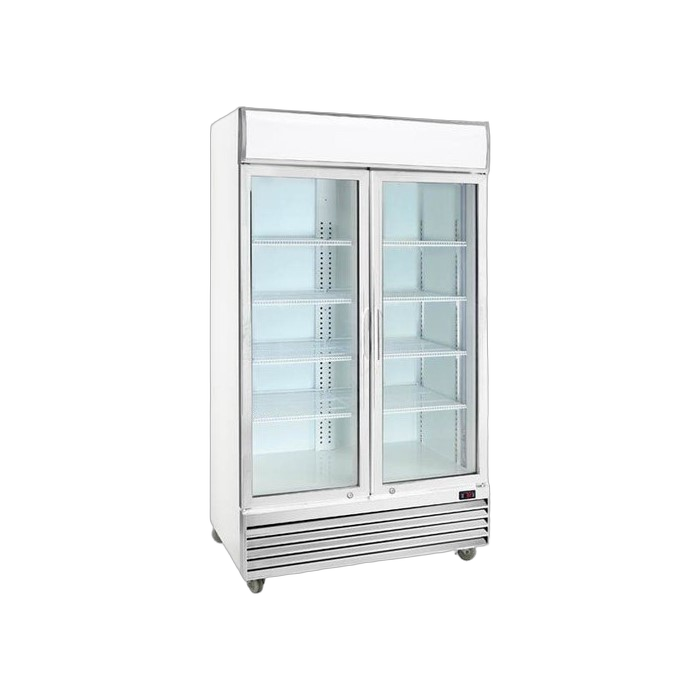
Upright (1–2 door) |
Most storage per m² of floor space; versatile placement |
Any application from retail display to kitchen storage — the default for most businesses |
Multi-door display cabinet (3–4 door) |
Maximum display frontage; high merchandising impact |
High-volume retail where display area directly drives revenue — bottle shops, supermarkets, convenience |
Underbench / counter-height |
Uses dead space under counters; arm’s reach access |
Bars, service counters, small kitchens — anywhere floor space is at a premium |
Choose upright when you need the best capacity-to-footprint ratio. A single 600 L upright occupies roughly 0.5 m² of floor space. An equivalent 600 L of underbench storage requires 2–3 units spanning 1.5–2.0 m of counter run. For most cafes, restaurants and small retail, an upright delivers more storage in less space at lower cost.
Choose multi-door display when merchandising frontage matters more than capacity per square metre. Three and four-door cabinets create a wall of product visibility that drives impulse purchases in convenience stores, bottle shops and supermarket aisles. The trade-off is higher purchase cost, more energy consumption and a larger footprint.
Choose underbench when the unit must sit within a service zone. Behind a bar or under a cafe counter, an underbench glass door unit keeps drinks and grab-and-go items within arm’s reach without taking floor space. Capacity is limited to 120–300 L, so most operations use underbench alongside a larger upright or storeroom unit.
Evaluate the key specifications
With your configuration confirmed, these are the specs that differ most between the three form factors and affect your purchasing decision.
Specification | Typical Range | Buyer Consideration |
|---|---|---|
External dimensions (W × D × H) |
Varies widely by configuration |
Measure your available space including clearance for door swing and rear ventilation (50–100 mm) |
Capacity (litres) |
120–1,500+ L |
Quoted capacity is gross — usable capacity with shelving loaded is typically 70–80% of the stated figure |
Ambient temperature rating |
Climate class 3 (25°C) to 5 (40°C) |
In non-air-conditioned environments in QLD, WA or NT, specify climate class 4 or 5 to maintain temperature |
Door hinge direction |
Left, right or reversible |
Critical for underbench units in tight service areas — wrong hinge blocks workflow |
Castors or levelling feet |
Standard on uprights; feet on underbench |
Castors make cleaning and maintenance access easier — locking castors prevent movement |
Noise level |
38–55 dB |
Underbench and display units in dining or retail areas should sit below 45 dB to avoid customer impact |
Understand the full cost breakdown (2026 prices)
Purchase price is only part of the picture — configuration choice also affects energy consumption and maintenance cost over the unit’s life.
Category | Price Range (AUD) | Typical Configuration |
|---|---|---|
Single door upright fridge |
$1,200–$3,500 |
200–400 L, retail or cafe |
Double door upright fridge |
$2,500–$6,000 |
600–1,000 L, hospitality or medium retail |
Multi-door display cabinet |
$4,000–$12,000+ |
1,000–1,500+ L, supermarket or large retail |
Underbench glass door fridge |
$1,000–$3,500 |
120–300 L, bar or service counter |
Freezer variant (any config) |
+20–40% over fridge equivalent |
Heated glass and higher compressor output add to both purchase and running cost |
Used / refurbished |
$500–$4,000 |
Check compressor hours, seal condition and refrigerant type |
Annual energy — upright |
$350–$900 |
Varies by size and star rating |
Annual energy — multi-door |
$700–$1,800 |
Larger glass area = more heat ingress |
Annual energy — underbench |
$250–$500 |
Smaller capacity and glass area keeps energy low |
Over a 10-year life, a multi-door display cabinet costing $8,000 with $1,200/year energy and $500/year maintenance totals $25,000 in TCO. An equivalent storage volume achieved with two upright units at $3,500 each, running $700/year energy each and $300/year maintenance, totals $27,000 — slightly more in capital but more flexible in placement. The financial difference is often marginal, so the decision should hinge on whether maximum display frontage or flexible placement is the priority. Request quotes from glass door fridge suppliers on HospitalityHub to compare pricing across all three configurations.
Decision framework — upright vs display cabinet vs underbench
Decision Factor | Upright | Multi-Door Display | Underbench |
|---|---|---|---|
Storage per m² |
????? |
??? |
?? (uses dead space) |
Display impact |
??? |
????? |
?? |
Energy efficiency |
???? |
?? |
???? |
Purchase cost |
$1,200–$6,000 |
$4,000–$12,000+ |
$1,000–$3,500 |
Placement flexibility |
????? |
?? (needs wall run) |
??? (counter-dependent) |
Speed of access |
??? |
??? |
????? |
Noise suitability |
Moderate — varies by model |
Higher — larger compressor |
Quiet models available (38–42 dB) |
Evaluate suppliers
You are ready to go to market. Use this checklist to assess each supplier against the same criteria.
Factor | What to Ask |
|---|---|
Configuration range |
Does the supplier offer all three configurations (upright, display, underbench) from the same brand? |
Custom sizing |
Are custom dimensions or non-standard configurations available for unusual spaces? |
Energy data |
What is the stated annual kWh for each model, and is GEMS registration data available? |
Climate rating |
What ambient temperature class is each model rated for? Specify Class 4 or 5 for hot environments. |
Glass and door spec |
Is the glass heated, double-glazed and self-closing? What hinge options are available? |
Warranty |
What is the warranty on compressor, cabinet and glass? Are parts and labour both covered? |
Service network |
Is there a local service agent in your state (NSW, VIC, QLD, WA, SA)? |
Spare parts |
Are replacement shelves, seals, handles and compressor parts stocked in Australia? |
Delivery and installation |
Is positioning and levelling included? What is the lead time and cost for interstate delivery? |
Volume discounts |
Are multi-unit or multi-site discounts available for hospitality groups? |
Frequently asked questions
Which glass door fridge configuration gives the most storage in the smallest footprint?
Upright single and double-door units deliver the highest litres-per-square-metre of floor space. A 600 L upright occupies approximately 0.5 m², while equivalent underbench capacity requires 2–3 units across 1.5–2.0 m of counter run.
When does a multi-door display cabinet make more financial sense than multiple uprights?
When merchandising frontage directly drives sales — typically in convenience stores, bottle shops and supermarket aisles. The premium for a multi-door cabinet is justified if the additional display area generates enough incremental sales to cover the higher energy and purchase cost.
Can i use an underbench unit AS my only fridge?
Only if your total refrigerated stock requirement is under 300 L. Most hospitality businesses use underbench units as point-of-service access alongside a larger upright or walk-in for primary storage.
Are glass door freezer versions available in all three configurations?
Upright and multi-door display freezers are widely available. Underbench glass door freezers are less common and carry a significant premium due to the insulation and heating requirements in a compact frame — expect 40–60% above equivalent fridge pricing.
What should i specify for a high-ambient environment like a non-air-conditioned retail space in QLD?
Specify Climate Class 4 (30°C ambient) or Class 5 (40°C ambient), heated double-glazed glass, and an inverter compressor. Units rated below Class 4 will struggle to maintain temperature in hot conditions, leading to compressor strain and shortened life.
Summary
- Upright glass door units are the default choice for most businesses — best storage-to-footprint ratio and widest price range ($1,200–$6,000)
- Multi-door display cabinets ($4,000–$12,000+) are built for high-volume retail merchandising where display frontage drives sales
- Underbench units ($1,000–$3,500) use dead space under counters — ideal for bars and service zones but limited to 120–300 L
- Freezer variants cost 20–40% more across all configurations due to insulation and heated glass
- Energy cost over 10 years is often the largest cost component — specify the highest available energy rating
- Match climate class to your environment — Class 4 or 5 for non-air-conditioned spaces in hot climates
Ready to source your commercial glass door fridge or freezer?
Don’t waste time contacting suppliers individually. HospitalityHub gives you direct access to verified Australian commercial refrigeration suppliers — compare models, specs and pricing in one place, then request quotes from suppliers best matched to your operation.
- Compare models — filter by capacity, configuration and region
- Request quotes — contact multiple verified suppliers with a single enquiry
- Contact suppliers directly — speak to specialists who service your state
→ Compare Commercial Glass Door Fridges on HospitalityHub Now →