

Key takeaways
Factor | Typical Range / Value | Buyer Implication |
|---|---|---|
Single-door upright fridge (new) |
$1,500–$3,500 AUD |
300–650L capacity; suits cafes, small kitchens and back-bar storage |
Two-door upright fridge (new) |
$2,500–$5,500 AUD |
600–1,300L capacity; standard for mid-size restaurants and bistros |
Upright freezer (new) |
$2,000–$6,000 AUD |
Operates at –18°C to –22°C; must meet FSANZ frozen food storage requirements |
Fridge temperature requirement |
1°C–5°C |
Food Standards Code Standard 3.2.2 requires cold food held at 5°C or below |
Energy consumption |
1.1–4.4 kWh/day |
Running costs vary 4x between efficient and inefficient models — check energy star rating |
Gastronorm compatibility |
GN 1/1 standard |
Non-GN units create inefficiencies with standard kitchen containers — confirm before purchasing |
Useful asset life |
8–12 years |
Compressor and door gasket maintenance are the primary factors in reaching the upper range |
What is a commercial upright fridge or freezer — and which do you need?
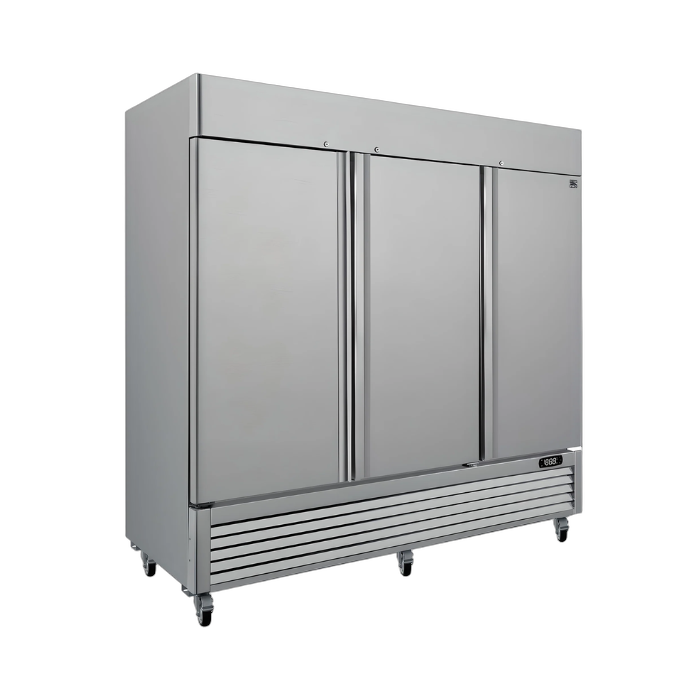
A commercial upright fridge or freezer is designed for continuous use in professional kitchens, with higher cooling capacity, stronger seals and faster recovery than domestic units. Choosing the wrong unit impacts food safety compliance, energy costs and long-term reliability — making specification one of the highest-impact decisions in a kitchen fit-out.
For Australian hospitality venues, refrigeration is not discretionary equipment — it is a food safety compliance requirement under the Food Standards Code and a direct driver of food cost through spoilage. Choosing undersized, underpowered or non-compliant units is one of the most common and costly mistakes in a kitchen fit-out or equipment upgrade. This guide walks cafe owners, restaurant managers and hospitality operators through the four decisions that resolve a commercial upright fridge or freezer purchase. Browse verified Australian suppliers at HospitalityHub to compare current models alongside this guide.
Commercial upright fridges and freezers are standard equipment across:
- Restaurants and bistros requiring back-of-house ingredient storage
- Cafes and coffee shops storing dairy, prepared food and beverages
- Hotels and clubs with high-volume kitchen operations
- Bakeries and patisseries requiring chilled ingredient and finished product storage
- Pubs and bars needing back-bar and kitchen refrigeration
- Catering operations, aged care facilities and institutional kitchens
Choose your configuration
Before sizing or specifying features, confirm which configuration your kitchen needs. Your menu type, service volume and kitchen layout determine this — and getting it wrong means either undersized storage that breaks food safety compliance or oversized equipment burning energy and taking up floor space you don't have.
Configuration | Capacity | Best For |
|---|---|---|
Single-door upright fridge |
300–650L |
Cafes, small kitchens, back-bar storage, secondary ingredient fridge |
Two-door upright fridge |
600–1,300L |
Mid-size restaurants, bistros, hotels — primary kitchen storage |
Three or four-door upright fridge |
1,200–2,000L+ |
High-volume kitchens, large hotels, institutional catering |
Single-door upright freezer |
300–700L |
Cafes, small venues, supplementary frozen storage |
Two-door upright freezer |
700–1,400L |
Restaurants, pubs and clubs with high frozen product turnover |
Combination fridge/freezer |
400–1,000L total |
Smaller venues needing both functions in a single footprint |
A practical sizing rule for fridge capacity: allow 0.5L of refrigeration per meal served per day as a minimum starting point. A venue serving 100 covers per day needs at least 50L of active fridge capacity for perishables at service — in addition to bulk storage. Under-specifying is the more common mistake; food safety inspectors in NSW, VIC and QLD regularly flag inadequate refrigeration capacity during routine inspections. Once configuration is confirmed, move to Step 2 to evaluate the specifications that matter.
Evaluate the key specifications
With your configuration confirmed, these are the specifications that determine whether a given unit actually performs in a commercial kitchen environment.
Specification | Typical Range | Buyer Consideration |
|---|---|---|
Temperature range (fridge) |
1°C–8°C |
Must reliably hold 5°C or below under load — FSANZ Standard 3.2.2 requirement |
Temperature range (freezer) |
–18°C to –22°C |
Must maintain –18°C under load; check ambient rating for hot kitchen environments |
Ambient temperature rating |
25°C–43°C |
Kitchen temperatures often exceed 35°C — units rated below this will underperform and fail early |
Gastronorm compatibility |
GN 1/1 standard |
GN-compatible shelving accommodates standard pans without decanting — essential for busy kitchens |
Door type |
Solid stainless or glass |
Glass suits front-of-house display; solid suits back-of-house where energy efficiency is the priority |
Condenser location |
Top-mount or bottom-mount |
Top-mount runs cooler and more efficiently in hot kitchens; bottom-mount is easier to clean |
Energy consumption |
1.1–4.4 kWh/day |
Efficient models cut annual running costs by $200–$600 per unit — check energy star rating |
Refrigerant type |
R134a, R290, R404A, R452A |
R290 (propane) is increasingly common for lower GWP — confirm technician availability in your area |
Door gasket type |
Magnetic self-closing |
Removable gaskets reduce cleaning time and replacement cost — confirm before purchase |
Understand the full cost breakdown (2026 prices)
Purchase price is only part of the picture — energy running costs operate 24 hours a day, 365 days a year, and are where the difference between an efficient and inefficient unit compounds most significantly over the asset's life.
Cost Category | Typical Range (AUD) | Notes |
|---|---|---|
Single-door upright fridge (new) |
$1,500–$3,500 |
300–650L; entry price for GN-compatible solid-door units |
Two-door upright fridge (new) |
$2,500–$5,500 |
600–1,300L; glass door adds $300–$800 to price |
Single-door upright freezer (new) |
$2,000–$4,000 |
300–700L; heated glass door adds cost but prevents condensation |
Two-door upright freezer (new) |
$3,500–$6,000 |
700–1,400L; higher-spec units with digital controls and alarms |
Annual energy cost (efficient model) |
$150–$250/unit |
Based on 1.1–1.8 kWh/day at average commercial electricity rate |
Annual energy cost (standard model) |
$400–$700/unit |
Based on 3.0–4.4 kWh/day; gap compounds to $2,500–$4,500 over 10 years per unit |
Annual maintenance |
$200–$800/unit |
Condenser cleaning, gasket inspection, temperature calibration |
Compressor repair or replacement |
$600–$2,500 |
Primary failure risk after year 6–8; local refrigeration technician availability matters |
Door gasket replacement |
$80–$300 per door |
Every 3–5 years with heavy use; failed gaskets directly impact temperature compliance |
Pricing reflects 2026 Australian market conditions. The energy cost gap between an efficient and a standard model adds up to $2,500–$4,500 per unit over 10 years — often exceeding the purchase price difference between models. For a venue running three or four units, specifying energy-efficient equipment at purchase is the single highest-impact cost decision in the refrigeration category. For broader guidance on commercial freezer selection and running costs, see the HospitalityHub commercial freezer buyer's guide. Browse current models and request quotes at HospitalityHub commercial fridges.
Australian compliance requirements
- Food Standards Code Standard 3.2.2 requires that potentially hazardous food be stored at 5°C or below (refrigerated) or –15°C or below (frozen) — your unit must reliably hold these temperatures under full load, not just when empty
- Temperature monitoring: most state food safety regulations require temperature logs to be maintained; units with digital displays and alarm functions simplify compliance records for health inspections in NSW, VIC and QLD
- Refrigerant licensing: under the Ozone Protection and Synthetic Greenhouse Gas Management Act, only licensed refrigeration technicians (ARC licence) can handle refrigerants during service, installation or disposal — confirm your supplier uses licensed technicians
- Electrical compliance: all commercial refrigeration must be installed with an appropriate power supply and RCD protection; confirm the unit's power requirements (most run on standard 10A GPO) match your kitchen infrastructure
- Energy labelling: commercial refrigeration sold in Australia must comply with the Equipment Energy Efficiency (E3) programme; check the energy star rating label when comparing models
- Ventilation clearance: most upright units require 50–100mm clearance on sides and rear for condenser airflow — inadequate clearance causes compressor overheating and premature failure, and may void the warranty
Evaluate suppliers
You're ready to go to market. Use this checklist to assess each supplier before requesting a quote.
Factor | What to Ask |
|---|---|
Ambient temperature rating |
What is the maximum ambient temperature this unit is rated for, and has it been tested in Australian commercial kitchen conditions? |
Temperature compliance |
Can this unit maintain 5°C or below under full load with frequent door opening during a dinner service? |
Gastronorm compatibility |
Are the shelves and interior dimensions GN 1/1 compatible as standard, or does this require additional shelving? |
Energy star rating |
What is the energy star rating and daily kWh consumption, and can you provide the E3 programme data? |
Refrigerant type |
What refrigerant does this unit use, and are ARC-licensed technicians available to service it in my area? |
Warranty terms |
What does the warranty cover — compressor, parts and labour separately? What is the compressor warranty period? |
Local service coverage |
Do you have service technicians or an authorised service partner in my city, and what is the typical callout response time? |
Spare parts availability |
Are door gaskets, shelving and compressor parts stocked locally, or are they imported to order? |
Delivery and installation |
Is delivery and positioning included in the price, and will the unit be checked for correct operation on site? |
Ventilation requirements |
What clearance does this unit require on sides and rear, and will it fit in my planned location with adequate airflow? |
Frequently asked questions
What temperature must a commercial fridge operate at in Australia?
Under Food Standards Code Standard 3.2.2, potentially hazardous food must be stored at 5°C or below. In practice, set your fridge to 1°C–3°C to allow headroom for door-opening temperature fluctuations during a busy service — this keeps food consistently below the 5°C threshold even under load.
What does gastronorm compatible mean, and why does it matter?
Gastronorm (GN) is the standard sizing system for commercial kitchen containers, trays and pans. A GN-compatible fridge has interior shelving dimensions that accommodate standard GN 1/1 pans without adapters or decanting, which significantly reduces prep time and cross-contamination risk in busy kitchens. Non-GN units force staff to transfer food between containers, adding labour and food safety risk.
How much does it cost to run a commercial fridge per year?
An energy-efficient commercial fridge consuming 1.1–1.8 kWh/day costs approximately $150–$250 per year to run at average commercial electricity rates. A standard model consuming 3.0–4.4 kWh/day costs $400–$700 per year. Over 10 years, the gap per unit is $2,500–$4,500 — a material difference for venues running multiple units.
What ambient temperature rating do i need for a commercial kitchen in Australia?
Commercial kitchens in QLD, NSW and WA commonly reach 35°C–40°C during service. Specify a unit with an ambient rating of at least 38°C–43°C to maintain performance under these conditions — units rated only to 25°C or 32°C will struggle to hold temperature, consuming more energy and failing the compressor earlier.
How long does a commercial upright fridge last?
Well-maintained commercial upright fridges last 8–12 years. The compressor is the primary failure point; models with top-mounted condensers generally run cooler and last longer in hot kitchen environments. Regular condenser cleaning (every 3–6 months) and door gasket replacement when sealing deteriorates are the two highest-impact maintenance actions for extending service life.
Summary
- Commercial upright fridges must maintain 5°C or below under load — Food Standards Code Standard 3.2.2 compliance is non-negotiable, not a preference
- Ambient temperature rating is the most commonly overlooked spec — specify 38°C–43°C minimum for Australian commercial kitchens
- Gastronorm compatibility should be confirmed before purchase — non-GN units create daily inefficiencies in any professional kitchen
- Energy consumption varies 4x between efficient and standard models — the cost gap over 10 years per unit is $2,500–$4,500
- ARC-licensed technicians are required for all refrigerant handling — confirm local service coverage before committing to a brand or model
- Compressor health and door gasket condition are the two variables that most affect compliance, running cost and service life — both require scheduled maintenance
Ready to source your commercial fridge or freezer?
Don't waste time contacting suppliers individually. HospitalityHub gives you direct access to verified Australian commercial refrigeration suppliers — compare models, specs and pricing in one place, then request quotes from suppliers best matched to your venue.
- Compare models — filter by capacity, door configuration and region
- Request quotes — contact multiple verified suppliers with a single enquiry
- Contact suppliers directly — speak to specialists who service your state
→ Compare Commercial Upright Fridges and Freezers on HospitalityHub Now

-160x160-state_article-rel-cat.png)
-160x160-state_article-rel-cat.png)


