

Key takeaways
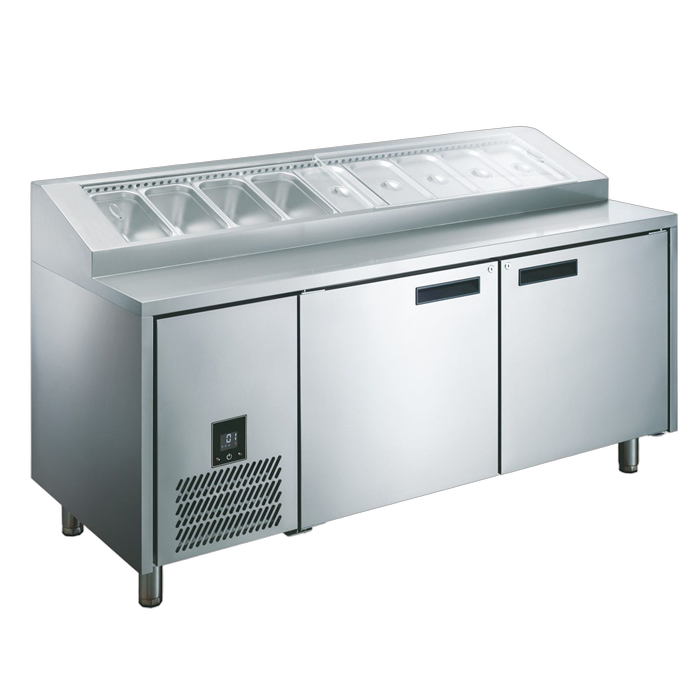
- What it is: A refrigerated workbench with a raised pan rail on top and chilled storage below, built to assemble pizzas at speed while keeping toppings food-safe.
- Price range: New units cost roughly $1,800 to $6,500 in Australia in 2026, depending on door count, capacity and brand.
- Configuration: Two-door units suit single-oven pizzerias; three-door units suit high-volume operations running two or more ovens.
- The specs that matter: GN pan capacity and depth, worktop material, and holding temperature under load.
- Compliance: The Food Standards Code requires potentially hazardous food held at 5 degrees C or below, so the unit must hold temperature during service.
Pizza remains one of the highest-margin categories on an Australian menu, and the prep fridge is the piece of equipment that decides how fast you assemble, how much topping you waste, and whether you pass a health inspection. Choose the wrong configuration or an underspecified unit and you pay for it every service. This guide covers the configurations, the specs that separate a good unit from a frustrating one, the compliance you cannot skip, and how to match a fridge to your kitchen.
Why the right prep fridge matters
Pizza is a volume game, and the prep fridge sits at the heart of it. With cafes, takeaways and casual dining venues all competing on speed and margin, a fridge that keeps toppings chilled and within reach directly affects service pace and waste. Australia's cafes and coffee shops alone are tracking to $15.9 billion in revenue in 2025-26, according to IBISWorld, and many of those venues run pizza or mixed prep off exactly this kind of counter.
The fridge also carries a compliance load. Toppings are potentially hazardous food, so the unit has to hold them at a safe temperature through a busy service with the lid open and pans being worked. A unit that cannot do that under load is both a food-safety risk and a waste problem.
Configuration: match doors to your volume
Before costing anything, confirm which configuration suits your layout and service volume:
- Two-door units: Suit single-oven pizzerias and lower-volume venues. Enough pan rail and storage for a focused pizza menu.
- Three-door units: Suit high-volume operations running two or more ovens, or mixed menus needing more prep space and cold storage below.
- Granite versus stainless worktop: Granite tops keep dough cooler during stretching, reducing sticking; stainless is easier to sanitise but warms faster in a hot kitchen. Most dedicated pizza units ship with granite.
If your menu is pizza-only with high topping turnover, a dedicated pizza prep fridge with a granite top and raised rail is the right call. If your menu is mixed, sandwiches, salads and wraps as well, a salad and sandwich prep fridge may be the more versatile choice.
The specs that decide the fit
Once configuration is set, these are the numbers to check on every quote:
- GN pan capacity: Most units hold 6 to 12 GN 1/3 pans on the raised rail. Match this to how many toppings your menu runs at once.
- Pan depth: Standard is 100 mm, but some units only accept 65 mm pans. Getting this wrong means replacing pans across your whole line, so confirm depth before ordering.
- Holding temperature under load: Set the unit to 1 to 3 degrees C so it holds toppings at or below the safe threshold even with the lid open during service.
- Compressor efficiency: Refrigeration runs 24/7, so a more efficient compressor cuts the largest ongoing cost over the unit's life.
- Footprint: Confirm the unit fits your line and leaves clearance for airflow and cleaning behind it.
| Spec | What to confirm | Why it matters |
|---|---|---|
| Doors | 2 vs 3 | Matches storage to oven count |
| Pan capacity | 6 to 12 GN 1/3 | Toppings available at once |
| Pan depth | 65 mm vs 100 mm | Avoids replacing your pans |
| Holding temp | 1 to 3 degrees C set point | Food-safety compliance under load |
| Worktop | Granite vs stainless | Dough handling vs cleaning |
Compliance you cannot skip
A prep fridge holds potentially hazardous food, so it sits under Australian food-safety rules. The Food Standards Australia New Zealand Code, Standard 3.2.2 requires potentially hazardous food to be held at 5 degrees C or colder (or 60 degrees C or hotter). For a prep fridge worked hard through service, that means:
- Set below the threshold: Run the unit at 1 to 3 degrees C so toppings stay compliant even as the lid opens and closes.
- Check it holds under load: A unit that drifts above 5 degrees C during a busy service fails the standard. Confirm holding performance, not just the headline temperature.
- Keep records: Environmental health officers in NSW, VIC and QLD check temperatures, so a working thermometer and a temperature log support compliance.
- Cleanable design: Surfaces and pans should sanitise easily to fit a documented cleaning schedule.
A realistic scenario
Picture a growing Sydney pizzeria upgrading from a single oven to two, and buying a two-door prep fridge to save money. Within weeks the fridge cannot keep pace: the pan rail is too small for the expanded topping range, staff run out of chilled toppings mid-rush, and the unit struggles to hold temperature with the lid open constantly.
A three-door unit sized to the two-oven volume would have carried the topping range and held temperature under load. The saving on the smaller fridge was wiped out by slower service and topping waste. The lesson is to size the fridge to where the kitchen is heading, not just where it is today. For a full purchase-and-running-cost breakdown, our pizza prep fridge prices guide sets out the five-year total cost of ownership.
Frequently asked questions
What does a pizza prep fridge cost in Australia?
New units run roughly $1,800 to $6,500 in 2026, depending on door count, capacity and brand. Entry two-door units start around $1,800; premium three-door granite-top models reach $6,500.
Two-door or three-door?
Two-door suits a single-oven pizzeria; three-door suits high-volume venues running two or more ovens or mixed prep. Size to your oven count and topping range, not just current volume.
What temperature should I run it at?
Set it to 1 to 3 degrees C so toppings stay at or below the 5 degrees C safe threshold even when the lid is open during service. Confirm the unit holds this under load.
Should I get a pizza or a salad prep fridge?
A dedicated pizza unit with a granite top suits pizza-only menus with high topping turnover. A salad and sandwich prep fridge is more versatile for mixed menus covering wraps, salads and sandwiches.
What matters most
A pizza prep fridge is chosen on configuration, capacity and compliance, not price alone. Match the door count to your oven count and topping range, confirm pan depth so you do not have to replace your pans, and check the unit holds 5 degrees C or below under a full service. Size it to where the kitchen is heading, and the fridge speeds service and protects margin; underspecify it and you pay in waste and slow rushes every shift.
Ready to compare configurations and pricing? Get quotes from pizza prep fridge suppliers across Australia here.


