
Key takeaways
- Throughput gap: Pass-through dishwashers process 40-70 racks/hour; conveyor dishwashers handle 100-300+ racks/hour - but many kitchens only require peak conveyor-level throughput for a portion of their operating hours.
- Purchase price: Pass-through $5,000-$18,000 vs conveyor $12,000-$55,000+ (2026 AUD) - conveyor typically costs around 2-3x more upfront at comparable wash quality and specification.
- Running cost gap: Conveyor models use significantly more water, energy and chemicals per hour of operation due to continuous running, but often less per rack at high volumes.
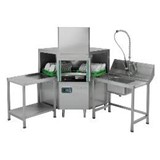
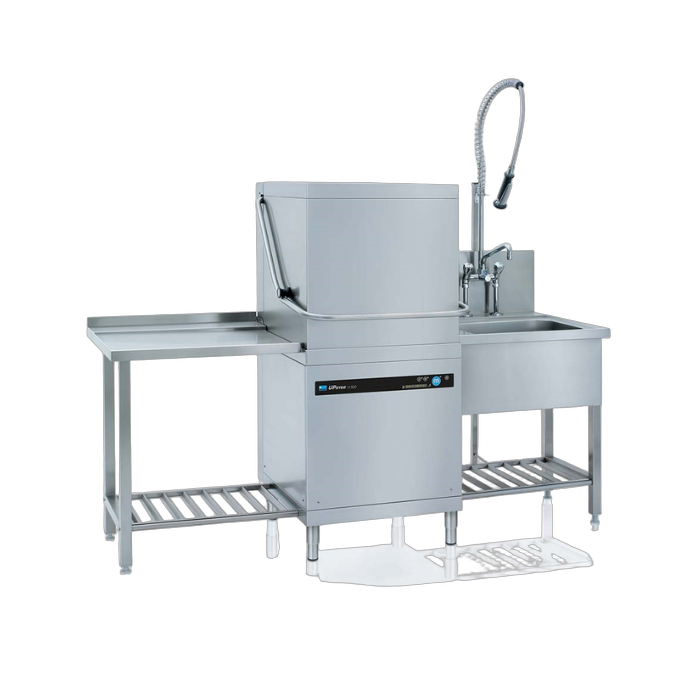
- Space requirement: A conveyor dishwasher needs 3-5 metres for the machine plus additional space for landing tables (typically 5-8 metres total) vs 0.6-0.8 metres for a pass-through - the footprint often decides the question before cost does.
- Staffing model: Pass-through needs one operator loading and unloading; conveyor typically requires one or two operators depending on layout and whether an auto-feed system is used - labour cost must be included in the comparison.
- Decision threshold: Conveyor justifies its cost at typically becomes viable at around 150-200+ racks per day depending on workflow and staffing. Below that, pass-through delivers lower TCO and smaller footprint.
- Both pass-through and conveyor dishwashers are available from verified Australian suppliers - pass-through and conveyor on HospitalityHub.
Pass-through vs conveyor dishwasher: Which earns its place in your kitchen? (2026 comparison)
Pass-through and conveyor dishwashers serve different volume thresholds, but the wrong choice shows up in two ways: a pass-through that cannot keep up during peak service, or a conveyor that runs at 30% capacity for 80% of the day. Both are expensive mistakes. The decision should be made on average daily rack count and available floor space, not peak-hour panic.
This comparison guide puts both machines side by side on throughput, cost, space, staffing and the decision factors that matter at procurement stage. For detailed running cost modelling on each type, see the conveyor dishwasher price guide. To compare pricing, get quotes for commercial dishwashers on HospitalityHub.
Operations where this comparison matters most:
- Hotels and resorts with variable covers - 80 midweek, 300+ weekend events
- Hospitals and aged care facilities with 3 meal services per day across multiple wards
- Function venues and conference centres with unpredictable volume spikes
- Large restaurants or RSLs considering upgrading from pass-through to conveyor
Compare the core differences
Before comparing costs, confirm which machine type matches your daily rack volume and kitchen layout. The table below covers the specifications that drive the decision.
Factor | Pass-Through | Conveyor |
|---|---|---|
Throughput |
typically 40-60 racks/hour |
100-300+ racks/hour |
Wash cycle |
60-120 seconds per rack (batch) |
Continuous flow - racks enter and exit without stopping |
Water use per rack |
2-3 litres |
1.5-2.5 litres (more efficient at high volume) |
Floor space |
600-800 mm wide |
3,000-5,000 mm linear + landing tables |
Power draw |
9-18 kW |
18-40 kW |
Staffing |
1 operator |
1-2 operators or auto-feed system |
Evaluate the key specifications
With the core differences clear, these are the specifications that determine which machine delivers better value for your specific operation.
Specification | Typical Range | Buyer Consideration |
|---|---|---|
Rack throughput |
40-300+ racks/hour |
Size on average daily racks, not peak-hour maximum - oversizing costs $10,000-$15,000 in wasted capital |
Rinse temperature |
82-90°C |
82°C is the minimum for thermal sanitisation under most Australian food safety codes |
Heat recovery |
Available on mid-range and above |
Reduces energy draw by 15-25% - essential on conveyors running 6+ hours/day |
Noise level |
Pass-through 55-65 dB; Conveyor 65-75 dB |
Conveyors in open-plan kitchens may need acoustic treatment - add $2,000-$5,000 |
Drainage |
Floor drain or pump-out |
Conveyor drains more water per hour - confirm floor drain capacity before ordering |
Compare the full cost (2026 prices)
Purchase price is only part of the picture. The table below models the approximate full 5-year cost at equivalent wash quality.
Category | Pass-Through | Conveyor |
|---|---|---|
New unit purchase |
$5,000-$18,000 |
$12,000-$55,000+ |
Installation |
$500-$1,500 |
$2,000-$4,000 |
Annual running cost (standard use) |
$3,000-$5,000 |
$5,000-$10,000 |
5-year TCO |
$20,000-$45,000 |
$37,000-$105,000 |
Cost per rack (at 100 racks/day) |
$0.10-$0.18 |
$0.15-$0.25 |
Cost per rack (at 250 racks/day) |
Can't handle efficiently |
$0.08-$0.14 |
At 100 racks/day, pass-through costs less per rack and less overall. At 200+ racks/day consistently, conveyor's continuous-flow efficiency makes it the lower per-rack option. For a pass-through at $5,000-$18,000, get quotes for pass-through dishwashers or for conveyor models at $12,000-$55,000+, get quotes for conveyor dishwashers from verified Australian suppliers.
Decision framework - pass-through vs conveyor
Decision Factor | Choose Pass-Through | Choose Conveyor |
|---|---|---|
Average daily racks |
Under 150 racks/day |
150+ racks/day consistently |
Available floor space |
Under 1.5 m linear - pass-through fits |
3-5 m linear available for machine + landing tables |
Staffing budget |
One dish operator per shift |
Two operators or budget for auto-feed system ($3,000-$8,000) |
Capital budget |
Under $18,000 |
$20,000-$55,000+ including installation |
Volume variability |
Highly variable (events, seasonal) - pass-through handles low days efficiently |
Consistent high volume daily - conveyor ROI depends on sustained throughput |
Evaluate suppliers
You are ready to go to market. Use this checklist to assess each supplier against the same criteria.
Factor | What to Ask |
|---|---|
Throughput at my rack count |
At my average daily racks, what is the actual cycle time and throughput per hour? |
Water and energy per rack |
What are the tested litres and kWh per rack at rated throughput? |
Space requirements |
What is the minimum linear space needed including landing tables and drainage access? |
Installation scope |
Is plumbing, electrical, drainage and commissioning included in the quoted price? |
Warranty |
What is covered and for how long? Are heating elements and conveyor chain included? |
Chemical system |
Does this model require proprietary chemicals or support third-party dosing? |
Service response |
What is the guaranteed response time for breakdowns in my area? |
Noise rating |
What is the tested dB level at rated throughput? Will it need acoustic treatment in my kitchen? |
Upgrade path |
If I start with pass-through and outgrow it, what is the trade-in or upgrade process? |
Finance |
Do you offer lease, hire-to-own or rental for either type? |
Frequently asked questions
At what rack volume does a conveyor dishwasher justify its cost over a pass-through?
Conveyor consistently beats pass-through on per-rack cost at 200+ racks per day. Between 100-200 racks, the decision depends on space availability, staffing model and volume consistency - variable-volume operations are usually better served by pass-through.
Can a pass-through dishwasher handle 200 racks per day?
Technically yes - at 60 racks/hour, a pass-through can process 200 racks in 3.5 hours of continuous operation. The question is whether your service pattern allows 3.5 hours of dedicated dishwashing or whether racks accumulate during peak and need faster processing.
How much more does a conveyor cost to run per year?
At comparable daily rack volumes (100-150 racks), conveyor costs $2,000-$5,000 more per year in combined water, energy and chemicals due to its larger tank, higher power draw and continuous operation cycle.
What floor space does a conveyor dishwasher actually need?
Plan for 3-5 metres of linear space for the machine itself, plus 1-1.5 metres at each end for landing tables and rack staging. Total footprint is typically 5-8 metres end-to-end including workspace.
Do both dishwasher types meet the same Australian food safety standards?
Both must meet AS/NZS 3500 for plumbing, AS/NZS 3000 for electrical and maintain 82°C final rinse temperature for thermal sanitisation. Conveyor models also need compliance with AS/NZS 4024 for machinery guarding on the conveyor mechanism.
Summary
- Pass-through is the lower-cost, smaller-footprint option for operations under 150 racks/day
- Conveyor justifies its 2-3x higher purchase price at 200+ racks/day sustained volume
- Floor space often decides the question before cost does - conveyors need 3-5 metres linear
- Size on average daily racks, not peak-hour volume - oversizing wastes $10,000-$15,000
- Conveyor staffing requires 2 operators or an auto-feed system - factor this into TCO
- Variable-volume operations (events, seasonal) are almost always better served by pass-through
Don't waste time contacting suppliers individually. HospitalityHub gives you direct access to verified Australian commercial dishwasher suppliers - where hospitality buyers request and compare multiple quotes so they can buy with confidence.
- Get quotes for pass-through dishwashers - contact multiple verified suppliers with a single enquiry
- Get quotes for conveyor dishwashers - compare throughput, energy rating and pricing
- Contact suppliers directly - speak to specialists who service your state
→ Get and compare commercial dishwasher quotes now → https://www.hospitalityhub.com.au/buy/commercial-dishwasher