

Key takeaways
- What the market is: Commercial washers on HospitalityHub list between $3,000 and $15,000, averaging around $9,000, spanning top-load, front-load washer-extractors, and barrier machines for hotels, aged care, healthcare, and laundromats.
- Start with load volume: Machine capacity sized to your daily kilograms of laundry decides everything downstream. Undersize and you bottleneck; oversize and you pay to heat and spin water you did not need.
- Front-load usually wins on running cost: Top-load machines cost less upfront but use more water and energy per cycle. Over a machine's life the cheaper purchase is often the more expensive choice.
- Match the machine to the sector: Healthcare and aged care need barrier washers and thermal or chemical disinfection. A standard machine that cannot meet hygiene requirements is not a saving, it is a compliance gap.
- Read total cost of ownership: Water, energy, spin efficiency, and servicing over years dwarf the purchase price. Compare machines on running cost, not the price tag.
A commercial washing machine is one of the hardest-working assets in a hotel, aged care home, or laundromat, and one of the easiest to buy wrong. The temptation is to compare purchase prices and pick the cheapest machine that fits the space. That approach ignores the two things that actually decide the cost over a machine's life: whether it is sized to your laundry volume, and how much water and energy it burns on every cycle. This guide works through the decisions in the order that matters, from load volume to machine type to compliance, so you choose a machine that pays for itself rather than one that quietly bleeds money.
Size to your laundry volume first
Capacity is the decision everything else hangs off, and getting it wrong is expensive in both directions. A machine too small for your daily load forces extra cycles, extends laundry hours, and wears the machine faster. A machine too large runs half-empty, heating and spinning water for loads that do not fill it. Work out your realistic daily laundry weight in kilograms, then size against that:
- Low to medium volume: Small guesthouses, cafes, and salons are usually well served by machines in the 6 to 10 kg range, close to a heavy domestic footprint but built for constant use.
- Medium to high volume: Hotels, gyms, and mid-size aged care sites typically need 10 to 20 kg front-load machines that can run back-to-back cycles all day without overheating.
- High volume: Laundromats, large accommodation, and healthcare laundries move into washer-extractors of 20 kg and beyond, where high spin speeds cut water retention and shorten downstream drying time.
Size to your average working day, not your busiest day of the year. Buying capacity for a peak that happens twice a year means paying to run an oversized machine every other day.
Choose the machine type for how it runs, not what it costs today
The machine type sets your running cost for the next decade, so this is where the total cost of ownership is won or lost. The main choices break down like this:
| Type | Best for | Cost profile |
|---|---|---|
| Top-load | Low to medium volume, tight upfront budgets | Cheaper to buy, higher water and energy use per cycle |
| Front-load | Most commercial sites running daily loads | Higher purchase price, lower water and energy per cycle |
| Washer-extractor | High-volume laundromats and accommodation | Highest purchase price, high spin cuts drying cost |
| Barrier washer | Healthcare and aged care hygiene zones | Premium price, required for infection control |
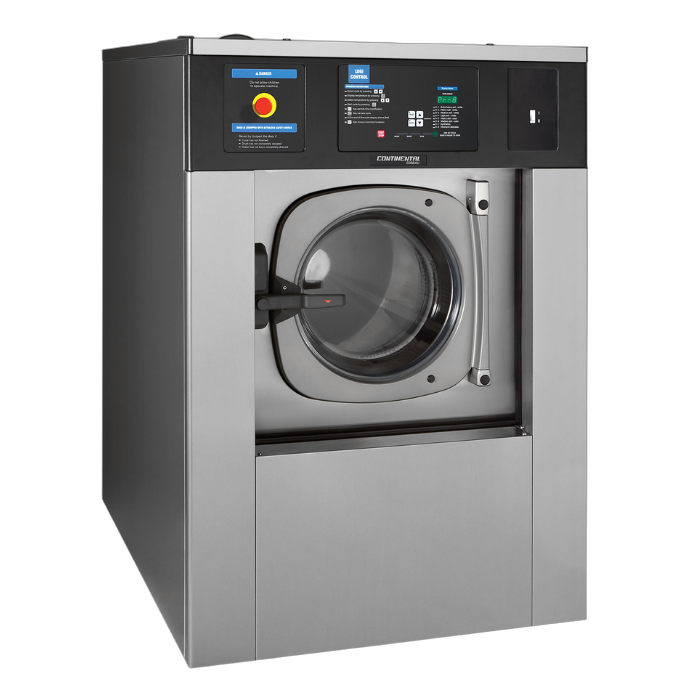
For most sites running daily loads, a front-load machine earns back its higher purchase price through lower water and energy use. Where drying is the bottleneck, a washer-extractor with a high spin speed leaves less moisture in the load, which cuts the time and energy your dryer has to spend. That link matters, because your washer and dryer share a running-cost budget: a cheaper washer that leaves clothes wetter simply pushes the cost onto the commercial dryer. Where floor space is tight, a stacked washer dryer combines both functions in one footprint.
Match the machine to your sector's hygiene rules
In some sectors, the wrong machine is not just inefficient, it is non-compliant. Healthcare, aged care, and other hygiene-critical settings need machines that can prove they kill pathogens, usually through thermal disinfection at a controlled temperature and hold time, or chemical dosing. Barrier washers take this further by separating the loading and unloading sides so clean linen never touches the contaminated zone.
Every commercial washer sold in Australia must also meet the electrical safety standard AS/NZS 60335.2.7, and a 2024 amendment adds a dual-action start requirement to prevent unintended activation, applying to machines supplied from mid-2026. If you buy for a hygiene-critical site, confirm the machine meets your sector's disinfection requirement before you compare anything else, because a cheaper machine that cannot meet it is not a candidate at all.
A realistic scenario
A 60-bed aged care home runs an ageing top-load washer that keeps falling behind on linen and staff uniforms. The manager is quoted $6,000 for a like-for-like top-load replacement and $11,000 for a front-load barrier washer with thermal disinfection.
The top-load machine is cheaper on the day and comfortably wrong. It cannot demonstrate the disinfection the site needs, and its higher water and energy use per cycle adds up fast across a home running laundry every day. The barrier washer costs more upfront, meets the infection-control requirement, and its lower per-cycle running cost narrows the gap every month it operates. Priced over the machine's life, the dearer purchase is the cheaper decision, and the only one that actually satisfies the site's obligations.
For a full breakdown of price bands by machine type and capacity, the commercial washing machine price guide for Australia sets out the numbers in detail.
The costs beyond the purchase price
The quote is the start of the bill. Factor these in before you compare machines on price alone:
- Water and energy per cycle: The single biggest lifetime cost. A high-efficiency front-load machine can use a fraction of the water of an older top-load unit on every wash, and that difference compounds across thousands of cycles a year.
- Installation and services: Larger machines may need three-phase power, adequate water pressure, and floor reinforcement for high-speed spin. Confirm your site can support the machine before it arrives.
- Servicing and parts: Budget for routine servicing and a supply of common wear parts. A machine from a brand with no local parts network stops being cheap the first time it waits weeks for a component.
- Warranty: Commercial washers commonly carry two to five year warranties. Longer cover on the components most likely to fail is worth paying for on a machine running every day.
Frequently asked questions
What size commercial washing machine do I need?
Size to your realistic daily laundry weight in kilograms, not your busiest single day. Small sites are often served by 6 to 10 kg machines, hotels and aged care by 10 to 20 kg, and laundromats and healthcare by 20 kg and above.
Is a front-load or top-load machine better for a business?
Top-load machines are cheaper upfront but use more water and energy. For most commercial sites running daily loads, a front-load machine's lower running cost makes it cheaper over the machine's life.
Do I need a special machine for aged care or healthcare?
Usually yes. Hygiene-critical sites need thermal or chemical disinfection, and often barrier washers that separate clean and dirty zones. Confirm the disinfection requirement before comparing prices.
Can I lease instead of buying outright?
Yes. Leasing spreads the cost over time and helps cash flow, though you should weigh total lease cost against outright purchase. Compare the long-run numbers rather than just the monthly figure.
What matters most
Buying a commercial washing machine well starts long before you compare prices. Size the machine to your real daily laundry volume so it runs full and efficient. Choose the machine type for its running cost over the next decade, not its price on the day, because water and energy per cycle decide the true cost. Confirm the machine meets your sector's hygiene and safety obligations before anything else. Then add installation, servicing, and warranty to every quote so you compare machines on their working lifetime cost. Get those right and the machine pays for itself. Get them wrong and even a cheap machine turns expensive.
Ready to compare capacities and running costs from trusted suppliers? Get quotes on commercial washing machines from suppliers across Australia here.


