
Key takeaways
| Category | Capacity | Buyer Implication |
|---|---|---|
| Countertop | 70–160 L | Suits cafes selling 10–20 slices/day — oversize wastes counter space and electricity |
| Freestanding single-door | 200–400 L | Suits bakeries with 30–60 units/day — adjustable shelves essential for whole cakes |
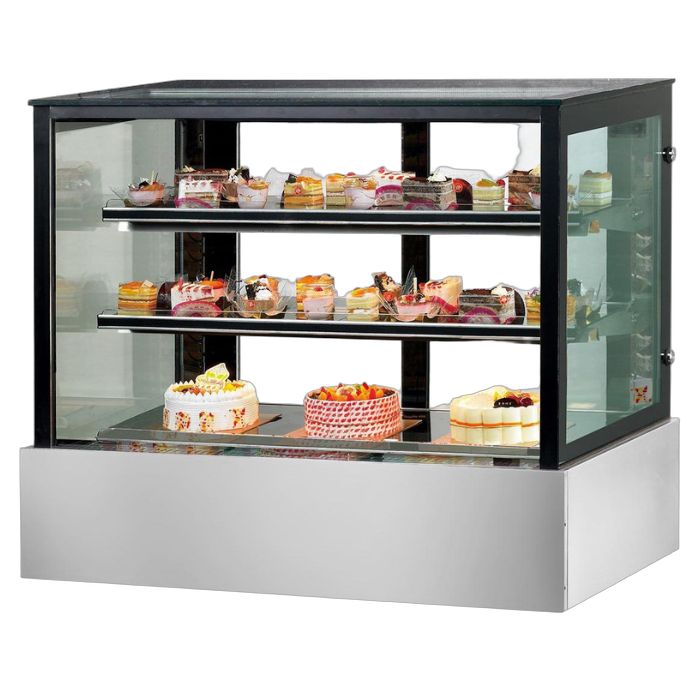
| Double-door / floor cabinet | 400–900 L | High-traffic venues — visual impact drives impulse purchases at this scale |
| Sizing formula | — | Peak display qty × product footprint × restock frequency + 25% airflow buffer |
| Shelf spacing | 300–350 mm max | Fixed shelves cannot fit whole cakes — adjustable is non-negotiable for bakeries |
| Compliance | 2–4°C range | FSANZ classifies cream and custard cakes as potentially hazardous — must stay below 5°C |
→ Compare cake display fridges on Hospitality Hub
Who this guide is for
An undersized cake display fridge means lost sales during peak service; an oversized one wastes electricity, floor space and capital. This guide helps cafe owners, bakery operators and hotel F&B directors in Australia calculate the right display capacity based on daily sales volume, product dimensions and restocking workflow.
Size categories
| Category | Shelves | Choose This If… | Avoid This If… |
|---|---|---|---|
| Countertop (70–160 L) | 2–3 | 10–20 slices/day, limited counter, impulse-buy positioning | You sell whole cakes — shelf spacing is too tight for anything above 150 mm |
| Freestanding single-door (200–400 L) | 3–5 | 30–60 units/day, mix of whole and sliced, dedicated display area | Peak service exceeds 60 units — you’ll restock mid-rush and lose sales |
| Double-door (400–700 L) | 5–8 | 60–100+ units/day, hotel lobby, event display, visual impact matters | Floor space under 1 m² — check external dimensions including ventilation clearance |
| Floor cabinet (500–900 L) | 4–6 wide | 100+ units/day, supermarket patisserie, food hall counter | Mixed temp requirements — two smaller units give you separate zones |
How to calculate the right size
Step 1: Count peak display requirement. How many items must be visible simultaneously during your busiest service? A cafe selling 20 slices at lunch needs all 20 displayed at once — not sequentially restocked. If you run out of display stock at 12:30 and can’t restock until 1:00, that’s 30 minutes of missed impulse sales.
Step 2: Factor in product dimensions. A whole cake (250–350 mm diameter, 100–200 mm height) takes roughly 5× more shelf area than a plated slice. A 300 L fridge holds ~4–6 whole cakes or 30–40 sliced portions. Map your product mix against shelf spacing before purchasing — this is where most sizing errors happen.
Step 3: Account for restocking frequency. If you restock from a walk-in every 2 hours, the display only needs 2 hours’ inventory. Morning-load-only operations need half a day’s stock. The less often you restock, the bigger the unit needs to be.
Step 4: Add 25% buffer. A packed fridge restricts airflow (especially ventilated models), raises internal temperature near the glass, and looks cluttered. A consistently full display fridge is undersized — it’s also a food safety risk if airflow restrictions push temps above 5°C.
What happens if you size wrong
| Sizing Error | What Happens | Financial Impact |
|---|---|---|
| Too small — display empties mid-rush | Lost impulse sales during peak; staff pulled from service to restock | A cafe losing 5 slice sales/day at $8 each = $10,000+/year in missed revenue |
| Too small — overpacked to compensate | Restricted airflow raises internal temp; product spoilage; FSANZ compliance risk | One council inspector noting temp excursions = improvement notice + audit cost |
| Too large — half-empty display | Looks poorly stocked; wastes $150–$400/year in excess electricity; ties up floor space | $1,000–$3,000 in overspend on the unit + ongoing energy waste |
| Wrong shelf config — fixed shelves for whole cakes | Can’t physically fit product; forced to cut cakes or display elsewhere | Entire purchase may need replacing — $2,500–$5,500 wasted |
Quick decision: Size by your operation
| Your Operation | Recommended Unit | Prioritise These Specs | What to Avoid |
|---|---|---|---|
| Small cafe, slices only, restocks 2×/day | 120–160 L countertop | Compact footprint, low noise, flat glass (saves 15–25%) | Freestanding units — too large for counter placement, wastes floor space |
| Bakery, whole + sliced, morning load | 300–400 L freestanding, adjustable shelves | Shelf spacing ≥300 mm, ventilated if self-serve, rear access for restocking | Fixed-shelf countertop units — can’t fit whole cakes regardless of volume |
| Hotel/venue, premium presentation, high traffic | 500–700 L double-door, curved glass | Visual impact, LED lighting, low noise for front-of-house, rotating shelves if self-serve | Budget flat-glass models — undercuts the premium positioning that justifies cake pricing |
| Large bakery/food hall, 100+ items, mixed categories | 700–900 L floor cabinet OR two 400 L units | Redundancy (two units), separate temp zones if mixing pastries and cream cakes | Single massive unit with no backup — one compressor failure = total product loss |
Supplier comparison checklist
| Factor | What to Ask |
|---|---|
| Usable shelf area | How many whole cakes (300 mm diameter) fit per shelf? Don’t rely on litre capacity alone. |
| Shelf adjustability | Are shelves adjustable? What is max shelf-to-shelf gap? Can shelves be removed entirely? |
| Cooling type | Ventilated or static? What is temp recovery after 30 seconds of door opening? |
| Energy consumption | Annual kWh? GEMS registered? |
| Ambient rating | Max ambient temp to maintain 2–4°C? Critical for non-airconditioned venues. |
| Warranty split | Compressor warranted separately (often 3–5 years vs 1–2 for cabinet)? |
| Spare glass | Replacement panels sourced locally? Cost and lead time? |
| Noise level | Operating dB? Matters for front-of-house near customer seating. |
| Delivery | Delivery to site included? Electrician needed for hardwiring? |
| Trial or rental | Can you trial before purchase, or access rental for seasonal testing? |
Frequently asked questions
How many whole cakes fit in a 300 l display fridge?
Typically 6–10 whole cakes (250–300 mm diameter) across 3–4 adjustable shelves. Taller cakes need wider gaps, reducing total count — always verify with the supplier.
One large unit or two smaller ones?
Two units offer redundancy (if one fails, the other keeps product cold) but cost more per litre and take more floor space. Choose two if your venue has no walk-in backup; choose one if energy efficiency and space are priorities.
What temperature should a cake display fridge run at?
2–4°C for cream, custard and dairy-based cakes. These are classified as potentially hazardous food under FSANZ Standard 3.2.2 and must stay below 5°C at all times.
Does a bigger fridge use much more electricity?
Not linearly — a 400 L unit uses 30–50% more than a 200 L, not double. The incremental energy cost of sizing up one category is typically $100–$200/year, which is trivial against the revenue impact of running out of display stock.
Can i display non-cake items in the same fridge?
Yes, if all items need 2–4°C. Avoid strong-odour items near buttercream or cream — dairy-based frostings absorb flavours within hours in an enclosed cabinet.
Compare cake display fridges on hospitality hub
Hospitality Hub connects you directly with verified Australian cake display fridge suppliers — compare models, capacity and pricing in one place.
- Compare countertop, freestanding and floor cabinet models by capacity and cooling type
- Request quotes from multiple verified suppliers with a single enquiry
- Speak directly with hospitality equipment suppliers servicing your state
→ Compare Cake Display Fridges on Hospitality Hub Now →