
Commercial upright fridges vs underbench refrigeration: Which suits your kitchen?
Key takeaways
| Factor | Guidance |
|---|---|
| Upright fridge price (AUD, 2026) | $1,500–$6,000+ depending on capacity and compressor quality |
| Underbench unit price (AUD, 2026) | $1,200–$4,500 for bench-integrated refrigeration |
| Upright storage capacity | 400–1,400 litres |
| Underbench storage capacity | 120–400 litres |
| Power consumption — upright | 250–600W depending on capacity and insulation |
| Power consumption — underbench | 200–450W |
| Temperature range (both types) | 1°C–5°C |
| Most common setup | Both types combined — upright for bulk, underbench for prep stations |
Why buyers are comparing these two systems
Most commercial kitchens don't choose between upright and underbench refrigeration — they need both. The decision at each point in the kitchen comes down to whether you're storing ingredients or accessing them. Get the configuration wrong and you end up with either a workflow bottleneck at the fridge door during service, or prep stations running out of cold space mid-shift.
Operations commonly evaluating this decision include:
- Restaurants and hotel kitchens managing bulk ingredient storage
- Cafés and quick-service operations prioritising prep station efficiency
- Catering and events kitchens balancing volume with speed
- Bakery and pastry operations with specific temperature zone requirements
- Bars and beverage service areas needing bench-integrated cooling
Is this guide for you? If you're fitting out a new kitchen, expanding refrigeration capacity, or deciding how to split storage between bulk and prep — this guide gives you the comparison data to configure correctly. Browse verified Australian suppliers of commercial fridges and freezers to compare models and request quotes.
System type comparison
| Feature | Commercial Upright Fridge | Underbench Refrigeration |
|---|---|---|
| Typical capacity | 400–1,400 litres | 120–400 litres |
| Typical price (AUD, 2026) | $1,500–$6,000+ | $1,200–$4,500 |
| Installation | Freestanding, dedicated floor space | Integrated beneath existing worktops |
| Door configuration | 1–2 full-height doors | 2–3 doors or drawers |
| Best use | Bulk ingredient storage, back-of-house | Prep station access, front-of-kitchen |
| Common users | Restaurants, hotels, catering | Cafés, QSR, bars, sandwich stations |
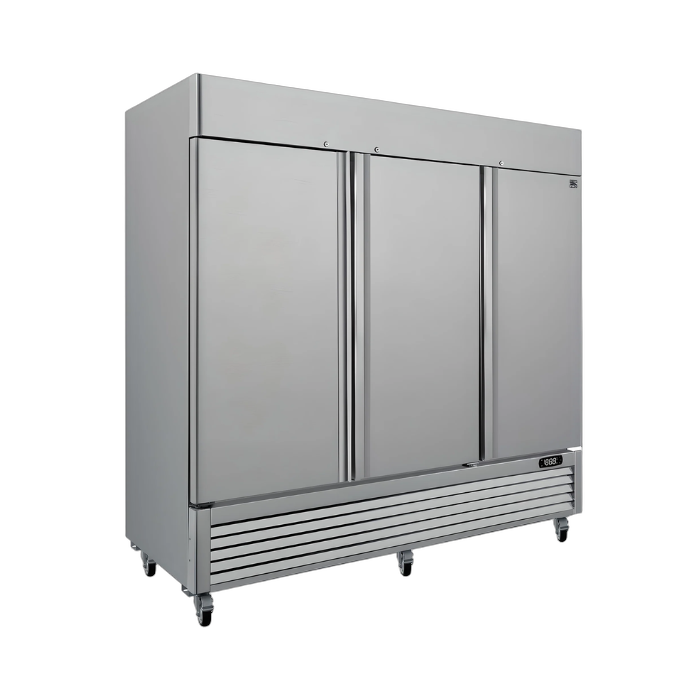
Upright refrigerators are the primary cold storage system in most commercial kitchens. The vertical format maximises storage capacity per floor area and suits bulk ingredient deliveries, pre-portioned prep and organised back-of-house storage.
Underbench units exist to solve a workflow problem, not a storage one. Keeping frequently used ingredients within arm's reach of a prep station — without the chef leaving their position — is what underbench refrigeration is actually for. Storage capacity is secondary to placement.
The most effective kitchen configuration combines both — upright units for bulk storage and underbench units at each active prep station. Most experienced kitchen operators arrive at this setup regardless of how they started.
Key specifications buyers should evaluate
| Specification | Typical Range | Buyer Consideration |
|---|---|---|
| Storage capacity | 120–1,400 litres | Size upright units to your largest single-day ingredient volume. Underbench capacity should match what's consumed per service at that station — not total kitchen volume. |
| Temperature range | 1°C–5°C | Both types operate in the same range. If you need separate zones for protein, dairy and produce, upright multi-zone units or separate dedicated underbench units are the practical solution. |
| Compressor type | Top-mount or remote | Top-mount compressors run warmer at the top of the unit — relevant for tall upright fridges in hot kitchens. Remote compressors reduce heat output in the kitchen but increase installation cost. |
| Door configuration | Full-height, half-height, drawers | Drawers on underbench units suit high-speed stations where one-handed access matters. Full-height doors suit back-of-house storage where visibility and shelf access take priority. |
| Power consumption | 200–600W | Refrigeration runs 24 hours — a 100W difference between models adds roughly $87 per year at standard commercial electricity rates. Multiply across a bank of units and efficiency spec matters. |
| Construction grade | Light commercial vs heavy-duty | Stainless steel interior and exterior with heavy-duty door hinges matters in a high-use kitchen. Light commercial units degrade quickly under service-level usage cycles. |
Technology or configuration options
| Factor | Standard Refrigeration | High-Efficiency / Feature Models |
|---|---|---|
| Compressor | Standard single compressor | High-efficiency inverter compressor |
| Temperature control | Manual or basic digital | Precision digital controller with alarms |
| Defrost system | Manual or timed | Automatic adaptive defrost |
| Energy consumption | Standard | 15–30% lower running cost |
| Price premium | None — standard | $500–$1,500 higher |
| Best application | Lower-use kitchens, secondary storage | High-use kitchens, primary cold storage |
Choose standard models for secondary storage, lower-use positions or where the unit runs moderate cycles. The lower purchase price is justified when usage doesn't warrant the efficiency premium.
Choose high-efficiency models for primary cold storage in high-volume kitchens running continuous service. The $500–$1,500 price premium on an inverter compressor unit typically recovers within 2–3 years through reduced electricity consumption on a unit running 24 hours daily. Digital temperature alarms also matter for HACCP compliance — manual temperature logging from a basic dial thermometer is a documented audit risk.
Costs in Australia
| Category | Price Range (AUD, 2026) | Typical Configuration |
|---|---|---|
| Entry underbench | $1,200–$2,000 | 2-door, 120–200L, light commercial |
| Mid-range underbench | $2,000–$4,500 | 3-door or drawer, 200–400L, heavy-duty |
| Entry upright | $1,500–$3,000 | Single door, 400–600L, standard compressor |
| Mid-range upright | $3,000–$4,500 | Double door, 800–1,000L, digital control |
| Industrial upright | $4,500–$6,000+ | Double door, 1,000–1,400L, heavy-duty, auto-defrost |
Refrigeration runs continuously — electricity is the dominant ongoing cost. At 400W average draw, a commercial upright fridge costs roughly $350–$450 per year to run at standard Australian commercial electricity rates. A 250W underbench unit adds approximately $220–$280 annually. Compressor servicing every 2–3 years typically costs $150–$400. Door gasket replacement — the most common maintenance item — runs $80–$200 per unit. Budget for gasket inspection annually in high-use kitchens; a failed seal raises internal temperature, increases compressor load and creates a food safety compliance issue simultaneously. Compare commercial fridge and freezer suppliers in Sydney to assess pricing, availability and local service coverage.
Australian compliance requirements
- Commercial refrigeration in food service must maintain product temperatures compliant with FSANZ Standard 3.2.2 — potentially hazardous foods must be stored at or below 5°C
- HACCP programs require documented temperature monitoring — digital temperature controllers with data logging capability satisfy this more reliably than manual checks
- Temperature records must be available for inspection under food safety program audits — units without logging capability require manual records at defined intervals
- AS/NZS 1731 governs refrigerating systems and heat pumps in commercial applications
- WHS obligations under the Work Health and Safety Act 2011 apply to installation, particularly for units requiring electrical hardwiring or gas refrigerant handling
- Refrigerant handling must be performed by a licensed technician holding an ARCtick licence under the Ozone Protection and Synthetic Greenhouse Gas Management Act 1989
- Food contact surfaces inside refrigeration units must comply with FSANZ food safety standard material requirements
Supplier comparison checklist
| Factor | What to Ask |
|---|---|
| Compressor type and warranty | Is this a top-mount or remote compressor, and what is the compressor warranty period? |
| Temperature controller | Does the unit have a digital controller with high-temperature alarm capability? |
| Construction grade | Is this light commercial or heavy-duty specification, and what is the door hinge rating? |
| Energy consumption | What is the actual power draw at operating temperature — not just the rated input? |
| Gasket and seal quality | Are door gaskets replaceable, and what is the replacement cost and lead time? |
| Refrigerant type | What refrigerant does this unit use, and is it compliant with current Australian regulations? |
| Service network | Do you have technicians in my state, and what is the response time for breakdowns? |
| Spare parts availability | Are compressors, gaskets and thermostats held in-country? |
| Warranty terms | What is the full unit warranty, and does it cover the compressor separately? |
| Delivery and installation | Is delivery to site included, and does the unit require electrical hardwiring? |
Frequently asked questions
How much does commercial refrigeration cost in Australia? Underbench units start from $1,200 for light commercial models and reach $4,500 for heavy-duty drawer configurations. Upright fridges range from $1,500 for single-door entry models to $6,000 or more for large-format industrial units with advanced temperature management. Always confirm whether the quoted price includes delivery and installation — hardwired units add $200–$600 in electrical costs that aren't always included in the equipment price.
Which type is better for a small commercial kitchen? Underbench refrigeration suits space-constrained kitchens where floor area is limited and workflow efficiency matters more than storage volume. A café kitchen running 40–60 covers per service typically needs one or two underbench units at prep stations and a single mid-range upright for bulk storage. If the kitchen has genuinely no room for an upright, a larger underbench bank is a workable compromise — but expect to manage ingredient volumes more tightly per delivery cycle. Kitchens that outgrow underbench-only configurations typically graduate to a coolroom for bulk ingredient storage rather than adding more upright units.
How do I know if my compressor is failing? The early signs are subtle — longer recovery times after the door is opened, ice build-up on the evaporator, or the unit running continuously without cycling off. In a busy kitchen these are easy to miss until the unit fails during service. Annual compressor servicing by a licensed refrigeration technician is the practical defence. A failed compressor during service on a high-use kitchen unit typically costs $600–$1,200 to replace — not including the food loss if temperatures rise before the fault is noticed.
Does it matter which refrigerant the unit uses? Yes. R134a and R600a are the most common refrigerants in commercial kitchen units and are compliant with current Australian regulations. Older R22 units are illegal to recharge in Australia and should not be purchased second-hand unless fully re-gassed with a compliant refrigerant. Any refrigerant handling — including recharging after a leak — must be performed by an ARCtick-licensed technician. Confirm the refrigerant type with the supplier before purchasing and verify current regulatory compliance.
How often should door gaskets be replaced? Gaskets in high-use commercial kitchens typically need replacement every 1–3 years depending on opening frequency and cleaning practices. A simple test: close the door on a piece of paper — if it pulls out without resistance, the gasket is no longer sealing. A failed gasket raises the internal temperature, forces the compressor to work harder and increases electricity consumption. It also creates a HACCP compliance risk if it allows the internal temperature to drift above 5°C. Budget $80–$200 per unit and inspect annually.
Summary
- Upright fridges suit bulk storage — underbench units suit prep station access — most effective kitchens run both
- Upright pricing runs $1,500–$6,000+; underbench $1,200–$4,500 depending on capacity and build grade
- High-efficiency inverter compressor models recover their $500–$1,500 price premium within 2–3 years on continuous service use
- Digital temperature controllers with alarm capability satisfy HACCP documentation requirements more reliably than manual monitoring
- ARCtick-licensed technician required for any refrigerant handling — confirm compliance before purchasing second-hand units
- Door gasket condition is the most commonly overlooked maintenance item — inspect annually and replace every 1–3 years in high-use kitchens
Ready to source your commercial refrigeration?
Don't waste time chasing individual suppliers. IndustrySearch gives you direct access to verified Australian commercial refrigeration suppliers — compare models, specs and pricing in one place, then request quotes from suppliers best matched to your operation.
- Compare models — filter by capacity, configuration and region
- Request quotes — contact multiple verified suppliers with a single enquiry
- Contact suppliers directly — speak to specialists who service your state
? Compare Commercial Fridges & Freezers on IndustrySearch Now →