
Key takeaways
- Purchase price: $3,000-$15,000 for an underbench; $8,000-$25,000 for a pass-through hood-type (AUD 2026) - but annual running costs of $3,000-$6,000 in water, energy, detergent and servicing accumulate to $15,000-$30,000 over 5 years.
- Water cost: $800-$2,500/year depending on machine type and racks per day - underbench units use 2-3L per cycle; pass-through units use 1.5-2.5L per cycle but run 3-5x more racks/hour.
- Energy cost: $600-$2,000/year - heat recovery models can reduce energy consumption by approximately 20–50% depending on usage and incoming water temperature but carry a $2,000-$5,000 unit price premium.
- Detergent and rinse aid: $1,000-$2,500/year - auto-dosing systems reduce chemical waste by 15-25% vs manual dosing and produce more consistent wash results.
- Preventive maintenance: $400-$1,200/year for descaling, seal replacement and thermostat calibration - necessary to support consistent performance and food safety compliance under AS 4674
- Payback vs hand-washing: A $5,000 underbench dishwasher saves 1.5-2 labour hours/day vs manual washing - at $30/hr casual hospitality rates, the payback is often within 4–6 months depending on labour cost and utilisation
- ATO depreciation: Effective life 10 years for commercial kitchen equipment - diminishing value rate 20%, prime cost rate 10%.
Commercial dishwasher running costs in Australia (2026): Water, energy and detergent breakdown
A commercial dishwasher at $5,000-$15,000 is a fixed-cost commitment that most venues budget accurately at purchase. The water, energy, chemical and maintenance costs that follow are not - and they typically exceed the purchase price within 3-4 years. Australian hospitality operations face additional pressure from commercial water rates that vary 40-60% between states, rising energy tariffs, and food safety audit requirements under AS 4674 that mandate specific rinse temperatures and documented maintenance schedules. This guide builds the complete annual and 5-year running cost model so your business case reflects what a dishwasher actually costs to operate - not just to buy.
This guide is for kitchen managers, venue owners and procurement leads responsible for warewashing equipment budgets across Australian hospitality operations in 2026. Get quotes for commercial dishwashers on HospitalityHub to compare supplier pricing alongside running cost models. Operations where dishwasher running costs are a material budget line include:
- Restaurants, cafes and bistros running 80-200+ racks/day across lunch and dinner service
- Pubs, clubs and RSLs with high-volume glassware and plate throughput across bar and kitchen
- Hotels and resorts with multi-outlet kitchen and room service warewashing demand
- Aged care and hospital kitchens with thermal disinfection compliance requirements
- Catering companies and function centres with peak-demand wash cycles across events
Confirm your dishwasher configuration - running costs vary by type
Before modelling any running cost, confirm which dishwasher type you are operating or purchasing. Your configuration determines water consumption per rack, energy draw, chemical dosing rate and throughput capacity - all of which set your annual cost floor.
Configuration | Key Cost Driver | Annual Running Cost |
|---|---|---|
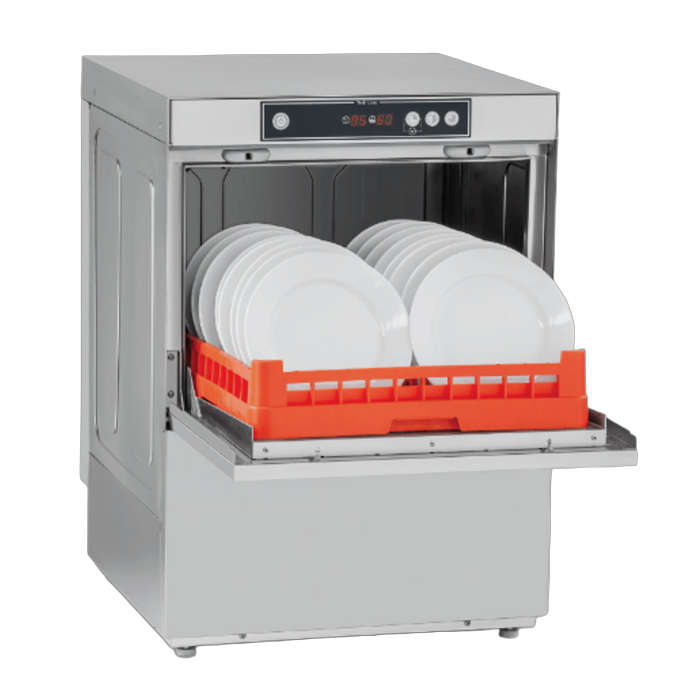
Underbench (500×500mm rack) |
Lower throughput, 2-3L/cycle - suited to cafes and small restaurants at 40-80 racks/day |
$2,500-$4,500 |
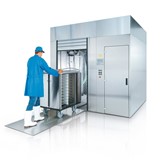
Pass-through hood-type |
Higher throughput, 1.5-2.5L/cycle, 40-60 racks/hr - suited to restaurants and pubs at 100-300 racks/day |
$3,500-$6,000 |
Pass-through with heat recovery |
Same throughput, 30-50% lower energy per cycle - higher unit cost, lower 5-year TCO |
$2,800-$4,800 |
Conveyor rack-type |
Continuous operation, 100-300 racks/hr - hotels, function centres, institutional kitchens |
$5,000-$10,000 |
Underbench models (Washtech XU, Eswood UC25, Norris Bantam) suit venues washing 40-80 racks/day - cafes, small restaurants, bar glasswashers. Lower unit cost but higher per-rack water and energy consumption than pass-through.
Pass-through hood-type models with heat recovery (Meiko M-iClean, Hobart PREMAX) are the lowest cost-per-rack option for any venue running 100+ racks/day - the heat recovery system pays back within 12-18 months in reduced energy cost.
Evaluate the key cost specifications
With your machine type confirmed, these are the specifications that determine how much you will spend annually - and which costs most venues miss entirely at purchase stage.
Specification | Typical Range | Cost Implication |
|---|---|---|
Water consumption per cycle |
1.5-3.5L |
At $3.50-$4.50/kL commercial water, a 2L/cycle machine at 150 racks/day costs approximately $1.00-$2.00/day in water depending on local tariffs |
Cycle time |
60-180 seconds |
Shorter cycles increase throughput and may increase total hourly energy use at high utilisation - match cycle time to your peak service pattern |
Rinse temperature |
82-85°C (thermal disinfection) |
AS 4674 requires adequate thermal disinfection (typically achieved via final rinse temperatures around 80°C or validated equivalent) - machines that do not consistently meet this under load may create a food safety compliance risk |
Heat recovery |
Yes / No |
Recovers waste heat to pre-heat incoming cold water - reduces energy consumption 30-50% per cycle |
Auto-dosing |
Yes / No |
Automatic chemical dosing reduces detergent and rinse aid waste by 15-25% vs manual dosing |
Drain pump |
Built-in / Gravity |
Built-in drain pump adds $200-$500 to unit price but allows flexible placement - gravity-drain units require floor drain proximity |
Full running cost breakdown (2026 prices)
Purchase price is only the start. Here is every running cost line for a pass-through hood-type commercial dishwasher running 100-200 racks/day in an Australian hospitality operation.
Cost Category | Annual Cost (AUD) | Notes |
|---|---|---|
Water |
$800-$2,500 |
Based on 1.5-2.5L/cycle, 100-200 racks/day, 300 days/year at $3.50-$4.50/kL commercial rate |
Energy |
$600-$2,000 |
6-12 kW rated input; heat recovery models reduce this by 30-50% at $0.28-$0.35/kWh commercial rate |
Detergent |
$600-$1,500 |
Auto-dosing at 2-4mL/cycle; manual dosing uses 20-30% more chemical per rack |
Rinse aid |
$300-$800 |
Required for spot-free drying and glass clarity - auto-dosing reduces waste |
Preventive maintenance |
$400-$1,200 |
Descaling (monthly in hard water areas), seal and gasket replacement, thermostat calibration, filter cleaning |
Rack and basket replacement |
$200-$600 |
Replacement racks at $40-$80 each - high-volume venues replace 3-8 racks/year due to wear |
5-year total running cost |
$15,000-$30,000 |
Water + energy + chemicals + maintenance over 5 years - excludes unit purchase price |
The five-year running cost of $15,000-$30,000 exceeds the purchase price for most commercial dishwashers in the $5,000-$15,000 range.Water and chemicals typically account for a large share of annual running costs, often in the range of 40–60% depending on usage and energy pricing. For a commercial dishwasher at $3,000-$25,000, get quotes for commercial dishwashers on HospitalityHub and ask each supplier for a cost-per-rack model at your expected daily throughput and local water rates.
Plan the asset - depreciation and financing
The ATO effective life for commercial kitchen equipment is 10 years - diminishing value rate 20%, prime cost rate 10%. Most single-unit dishwashers at $3,000-$25,000 fall within the $20,000 instant asset write-off threshold for the 2025-26 financial year. Conveyor models at $20,000+ may exceed this threshold depending on the current year's cap.
Lease and rent-to-own structures are common through providers like SilverChef on 12-36 month terms. For an $8,000 pass-through unit, a typical 24-month rental runs $350-$450/month - worth comparing against outright purchase where the venue has stable year-round trade rather than seasonal peaks.
Evaluate suppliers on running cost
You are ready to go to market. Use this checklist to assess what each supplier includes and excludes from their total cost picture.
Factor | What to Ask |
|---|---|
Water consumption per rack |
What is the rated water consumption per cycle - and does this include rinse or wash-only? |
Energy consumption |
What is the rated kW input and estimated annual energy cost at 100-200 racks/day? |
Heat recovery |
Does this model include heat recovery - and what is the price premium vs the non-recovery version? |
Chemical dosing |
Is auto-dosing built in or optional - and what detergent and rinse aid brands are compatible? |
Rinse temperature compliance |
Does this model maintain 82-85°C final rinse temperature under full load to meet AS 4674? |
Maintenance schedule |
What preventive maintenance is required and at what intervals - do you offer a service contract? |
Warranty scope |
What does the warranty cover - tank, pump, heating element, control board - and for how long? |
Installation requirements |
What plumbing, drainage and electrical connections are required - and is installation included in the quote? |
Spare parts |
Are replacement seals, heating elements, racks and wash arms held locally in Australia? |
Finance options |
Do you offer lease, rent-to-own or equipment finance through a hospitality finance provider? |
Frequently asked questions
What is the total annual running cost for a commercial dishwasher in an Australian hospitality venue?
A pass-through hood-type dishwasher running 100-200 racks/day costs $3,500-$6,000/year in combined water, energy, chemicals and maintenance. Underbench units at 40-80 racks/day run $2,500-$4,500/year.
At what rack volume does heat recovery justify its price premium?
Heat recovery adds $2,000-$5,000 to unit price but saves 30-50% on energy per cycle - the payback is typically 12–24 months for venues running around 100+ racks/day depending on energy costs and usage patterns. Below 60 racks/day, the energy savings rarely justify the premium.
What food safety standard applies to commercial dishwasher rinse temperature in Australia?
AS 4674 requires a minimum 80°C final rinse temperature for thermal disinfection in commercial food premises. Machines that drop below this temperature under peak load create a food safety compliance gap that health inspectors will flag.
How does auto-dosing reduce commercial dishwasher chemical costs?
Auto-dosing systems deliver precise detergent and rinse aid volumes per cycle, reducing chemical waste by 15-25% compared to manual dosing. The dosing pumps cost $200-$500 to add and pay back within 6-12 months on a high-volume machine.
What ATO depreciation applies to a commercial dishwasher purchase?
The ATO effective life for commercial kitchen equipment is 10 years - diminishing value rate 20%, prime cost rate 10%. Most single dishwashers fall within the $20,000 instant asset write-off threshold for the 2025-26 financial year.
Summary
- Five-year running costs of $15,000-$30,000 exceed the purchase price for most commercial dishwashers - water and chemicals account for 50-60% of annual cost
- Heat recovery models save 30-50% on energy and pay back within 12-18 months at 100+ racks/day
- Auto-dosing reduces chemical waste by 15-25% and produces more consistent wash results than manual dosing
- AS 4674 mandates 80°C minimum final rinse temperature - maintenance that allows this to drop creates a food safety compliance failure
- ATO effective life is 10 years with instant asset write-off available for most single-unit purchases
Don't waste time contacting suppliers individually. HospitalityHub gives you direct access to verified Australian commercial dishwasher suppliers - where hospitality buyers request and compare multiple quotes so they can buy with confidence.
- Get quotes for commercial dishwashers - contact multiple verified suppliers with a single enquiry
- Compare models - filter by type, throughput and region
- Contact suppliers directly - speak to specialists who service your state
→ Get and compare commercial dishwasher quotes now → https://www.hospitalityhub.com.au/buy/commercial-dishwasher